Butterfly pea adulteration red flags are the behavioral and analytical signals that tell a B2B buyer a lot of Clitoria ternatea may not be what the supplier claims — whether in species identity, color origin, organic status, or provenance. To be direct about where this desk stands: no documented butterfly pea–specific adulteration scandal is in the public record at the time of writing. What is documented, extensively, is that the broader botanical ingredient trade carries well-established adulteration risks — synthetic dye addition to inflate apparent color, substitution of one species for another, and false organic or origin claims backed by unverifiable paperwork. Butterfly pea attracts premium pricing for its unusual blue color and its growing demand as a natural food colorant, which puts it squarely in the risk profile of botanical categories where adulteration pays. This guide applies that general risk framework to the specific product, flags the detection tools that work, and lists the behavioral signals that should stop a purchase before a container ships.
Nothing in this piece is a claim that any named supplier or origin country is implicated in adulteration. It is pattern recognition from trade practice, applied to a category where scrutiny is warranted and where most buyers are currently exercising too little of it.
Why Butterfly Pea Is a Realistic Adulteration Target
The three conditions that make any botanical commodity attractive for adulteration are: meaningful price differential between grades or between authentic and substituted material; color or sensory properties that are difficult to distinguish visually; and buyer populations that lack either the testing budget or the institutional knowledge to check. Butterfly pea meets all three.
A premium whole-flower select lot from a well-managed Indonesian or Thai processor can command significantly more per kilogram than broken fines, milled powder from lower-grade feedstock, or mixed-species dried blue flowers. The color is the commercial value signal, which means color enhancement—whether by adding a small quantity of synthetic dye or by substituting a cheaper blue botanical—is the obvious fraud vector. And the buyer base for butterfly pea includes a high proportion of first-time importers in the natural food and beverage space who may have purchased based on a photograph and a supplier’s stated grade without a CoA or sample evaluation.
That combination does not prove adulteration is happening. It explains why a careful buyer should not assume it is not.
The Three Main Adulteration Risk Categories
Synthetic Dye in Butterfly Pea
The most commercially motivated fraud in a blue dried flower category is color enhancement using a synthetic blue dye. The appeal to an unscrupulous operator is obvious: a genuinely pale or degraded lot, perhaps from over-hot sun-drying or poor storage, can be made to look premium by adding a small quantity of synthetic dye before packaging. The buyer sees a vivid blue and pays a premium price for what is partially or substantially a cheaper underlying product.
Several synthetic blue dyes are approved for specific food uses in some markets (brilliant blue FCF / FD&C Blue No. 1, indigo carmine, patent blue V) while being restricted or prohibited in others. None of them is a legal additive to dried butterfly pea flower. If a synthetic dye is present in a lot marketed as pure natural dried Clitoria ternatea, the lot is adulterated under any food-law framework in the US, EU, or major markets in Asia-Pacific.
The visual tell is one clue: genuine ternatin blue is a complex anthocyanin color that sits at a particular wavelength profile and shows a characteristic pH shift. Synthetic dyes have their own absorption signatures and generally do not change color with pH changes the way ternatins do. A lot that is unusually vivid and uniform—more intensely blue than reference premium lots, without any of the natural variation in shade that comes from hand-sorting dried flowers—warrants analytical investigation rather than acceptance at face value.
But the visual check is not reliable enough on its own to clear a lot. Analytical detection is.
Species Substitution Dried Flower
Species substitution in the dried flower and botanical trade typically means replacing a higher-value species with a visually similar and lower-cost one, while labeling the product as the premium species. For butterfly pea, the relevant question is whether a lot sold as Clitoria ternatea actually contains that species, contains it as the majority of the material, or contains a mixture with cheaper blue-flowered botanical species.
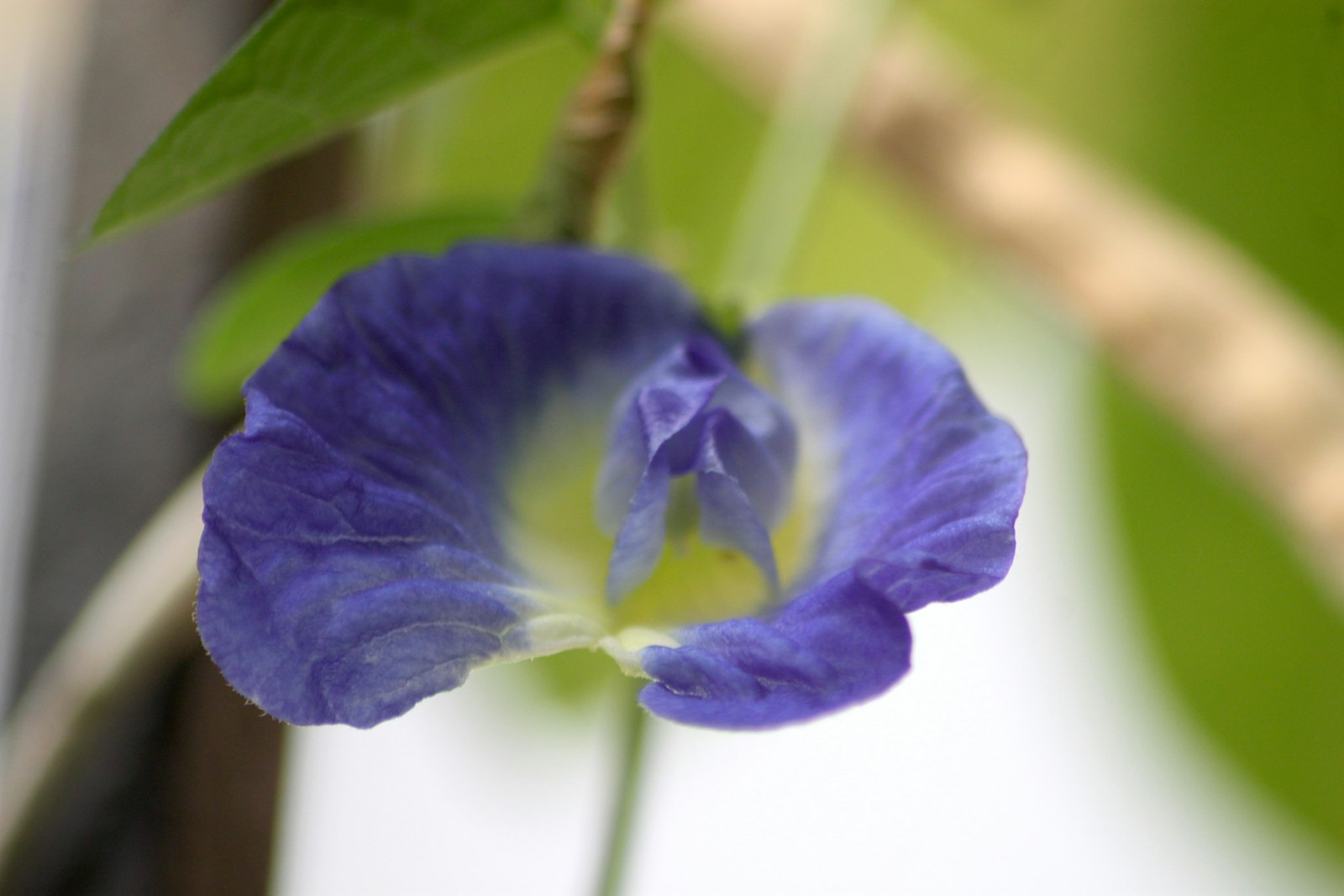
The substitution risk is higher in powder form than in whole flower, because powder destroys the morphological evidence—the characteristic papilionaceous shape of Clitoria ternatea, approximately 5 cm across and distinctively formed—that a botanically trained buyer can identify in a whole-flower lot. A whole-flower lot where every flower has the right shape and calyx structure is harder to substitute. A powder lot carries no such visual anchor. This is one reason botanical identity testing is more important for powder than for premium whole-flower grade, even though both warrant a CoA.
Species substitution need not be a complete swap. Adulteration sometimes involves extending a genuine lot with lower-cost filler. Dried petals from other blue or purple flowering plants, or low-grade fines from a different species, can be mixed into a butterfly pea flower lot before milling or packaging in proportions that are difficult to detect without analytical methods.
False Organic Origin Claim Butterfly Pea
The third major fraud category is paperwork fraud: a lot that is sold as certified organic, or as originating from a premium origin, when the underlying material is conventional (uncertified) or from a different and lower-cost origin.
Organic fraud in botanical commodities is well documented. It takes several forms. Sometimes a certifier is involved and the certificate is genuine for a small pilot quantity, which is then used to cover a much larger volume of conventional material. Sometimes a certificate from one operator is attached to a shipment from a different, uncertified operator. Sometimes an expired certificate is presented as current. The buyer who checks that a certificate exists and looks roughly correct is much more exposed than the buyer who verifies the certificate against the certifying body’s own database.
False origin claims are analogous. A lot claimed to be Thai-origin premium might actually be sourced from a lower-cost growing region but re-invoiced or relabeled through a Thai trader. The price premium attached to the claimed origin transfers to the seller without the quality guarantee that premium pricing implies. For butterfly pea buyers specifically, origin matters because drying practices, growing environment, and certification readiness vary meaningfully between Indonesia, Thailand, and Vietnam, and buyers paying for a specific origin expect the material to reflect those practices.
Detection: What the Lab Tests Actually Catch
Behavioral red flags (covered below) are useful screening filters. They are not a substitute for analytical testing. Here is what the laboratory toolkit looks like for each adulteration category.
Anthocyanin Fingerprinting by LC-MS: Detecting Synthetic Dye
Liquid chromatography–mass spectrometry (LC-MS) is the primary tool for distinguishing genuine butterfly pea anthocyanins from synthetic dye additions. Ternatins—the polyacylated delphinidin-based anthocyanins that give Clitoria ternatea its characteristic blue color and pH color-response—have a complex acylation pattern and a specific mass fragmentation profile that is well documented in the anthocyanin literature. A genuine lot will show a ternatin fingerprint with the expected acylated species at their characteristic m/z values. A lot doped with synthetic blue dye will show the dye’s own chromatographic and mass-spectral signature, which does not overlap with the ternatin profile.
High-Performance Thin-Layer Chromatography (HPTLC) is an alternative method for anthocyanin fingerprinting that some contract labs use as a lower-cost first screen. It is less specific than LC-MS but provides a visual fingerprint—the characteristic band pattern of butterfly pea anthocyanins—that can identify substitution or adulteration when compared against a reference standard. For high-value lots or first-time supplier qualification, LC-MS is the more defensible method.
The pH color-response test functions as a quick practical screen at goods receipt. Genuine ternatin blue shifts visibly from blue to purple to pink as acid is added. Many synthetic dyes are less pH-responsive or shift in a different pattern. A lot that barely responds to a few drops of lemon juice warrants analytical follow-up. But this is a screen, not a clearance: some synthetic dyes do show pH response, and a degraded genuine lot may show a weak shift.
DNA Barcoding: Species Identity Verification
DNA barcoding is the current gold standard for species identity verification in dried botanical materials. A short, standardized region of the plant genome—commonly the rbcL or matK chloroplast gene for plants, or the internal transcribed spacer (ITS) region—is sequenced from the sample and compared against a reference database. If the material is Clitoria ternatea, the sequence matches. If it is something else, it does not.
DNA barcoding works on both whole-flower and powder samples, although DNA quality and yield from heavily processed powder can be lower. For a first FCL commitment or for ongoing supplier qualification where species substitution would represent a material quality and regulatory failure, the cost of DNA barcoding is modest relative to the risk it covers. Reference labs in the US, EU, and Singapore all offer this service with commercially reasonable turnaround times.
HPTLC botanical ID is the other commonly used method, relying on the physical chromatographic fingerprint of plant constituents rather than genetic sequence. It is suitable for confirming the botanical identity of a lot that has not been heavily processed and where the anthocyanin profile has not been degraded to the point of unreadability. It is faster and less expensive than DNA barcoding but provides less definitive evidence in the case of processed or mixed material.
Color Strength and pH Behavior: Consistency Checks
A spectrophotometric color-strength measurement—absorbance at approximately 560–620 nm, where ternatins absorb most strongly—provides a baseline that can be written into the purchase specification and verified on every lot. A supplier who cannot or will not quantify color strength in the CoA is not meeting the minimum analytical standard for a color-critical ingredient. More importantly, a lot that shows unusually high absorbance compared to the supplier’s historical lots, or compared to reference benchmarks for equivalent grades, may have been color-enhanced.
Consistency of pH behavior—whether the infusion shifts from blue to purple to pink reproducibly at a known acid concentration—is a complementary check. Suppliers who have been working with this ingredient over multiple seasons should be able to provide reference absorbance data from previous lots, allowing the buyer to track lot-to-lot consistency. Sudden jumps in color intensity without a corresponding change in grade specification or drying practice deserve explanation.
Behavioral Red Flags: The Supplier Signals That Should Stop a Deal
These are the observable behaviors and document patterns that should trigger heightened scrutiny or a decision to walk away. None of them proves adulteration. Together, they are the buyer’s early-warning system.
Prices Well Below Indicative FOB Ranges
Indicative FOB ranges for butterfly pea whole flower from Indonesian and Vietnamese origins run approximately USD 6–12/kg for standard food-grade; premium and organic select whole flower at Thai-positioning runs approximately USD 10–20/kg at the top end. These are indicative by-quote ranges only, not a price board, and they vary by season, grade, volume, and certification status. A live quote is required for any real purchase.
That said, a supplier quoting USD 3/kg for certified-organic premium select whole butterfly pea flower ex-works Indonesia is offering something that does not add up against the visible cost structure of the product. FOB includes farm-gate flower cost, sorting, low-temperature drying, QC and lab testing, packaging, inland transport, export documentation, and seller margin. A price significantly below the lower end of the indicative range for a claimed premium grade is either a different grade than described, conventional material presented as organic, or a product whose cost has been cut somewhere it should not have been.
Extreme low pricing is one of the most reliable generic fraud signals across commodity trade. It is also the signal buyers are most likely to rationalize away when they want to find a good deal. Do not rationalize it away.
Unverifiable Certificates
A certificate that cannot be verified against the issuing body’s own database is not evidence of anything. This applies to organic certificates, HACCP and ISO 22000 certificates, and lab CoAs alike.
For USDA NOP organic, the issuing certifying agent should be searchable in the USDA’s organic integrity database at ams.usda.gov/organic-integrity, and the supplier’s operator name should appear under a current certificate. If it does not, the USDA organic claim is unverified. For EU organic, the control body must appear on the EU’s list of recognized third-country bodies, and the COI must be traceable in TRACES NT. For ISO 22000, the certifying body must be IAF MLA-accredited, and most maintain a public certificate search tool.
For CoAs, the issuing laboratory’s ISO 17025 accreditation status should be verifiable through the relevant national accreditation body—KAN in Indonesia, UKAS in the UK, A2LA or NVLAP in the US. A CoA bearing a laboratory name that cannot be found in any accreditation registry should be treated as unverified, regardless of how official the document looks.
Suppliers who present certificates but become evasive when asked for the certificate number, the certifying body’s name, or the specific scope of certification are exhibiting a behavioral red flag that calls into question whether a real certificate exists behind the document they have shared.
Refusal to Share the CoA or Allow Third-Party Testing
A genuine supplier with a clean product has no commercial reason to refuse a full CoA from an accredited laboratory. The CoA protects both parties: it gives the buyer the evidence they need and it gives the supplier legal documentation that the lot met specification at the time of dispatch.
Resistance to sharing a CoA, offering only a summary or a “certificate of conformity” in place of actual lab results, or citing confidentiality as a reason not to share test data are all red flags. Analytical results are not trade secrets; the underlying formulations and supplier relationships might be, but a moisture percentage, a microbiological count, and a pesticide residue table are not.
Refusal to allow a buyer to conduct third-party testing on a sample is a stronger red flag still. A supplier who insists the buyer must rely only on in-house or proprietary lab results, and will not permit the buyer to send a retained split sample to an independent ISO 17025-accredited lab of the buyer’s choosing, has removed one of the buyer’s primary tools for independent verification. Serious B2B suppliers in the botanical ingredient trade do not operate this way. A refusal should be treated as a disqualifying signal unless a very credible and specific explanation is offered.
Color That Looks Too Uniform or Unnaturally Vivid
This flag is subtler and requires reference experience, but it is worth naming explicitly. Premium dried Clitoria ternatea whole flowers show a rich, deep blue—but it is a natural blue that varies slightly across individual flowers depending on moisture at harvest, drying temperature, sun exposure during transport, and natural variation in ternatin concentration between plants. A lot that presents as perfectly uniform electric blue, without any flower-to-flower variation in shade, and that appears significantly more vivid than other lots at an equivalent grade, may have been treated.
Natural color variation is not a quality defect. It is expected. A processor who has sorted carefully to remove browned or faded flowers will have a visually consistent lot, but it will still have the natural depth and slight variation of a plant-derived pigment. Machine-vivid, plastic-uniform blue in a dried agricultural product is not what a genuine lot looks like.
This flag should prompt a pH color-response test and an LC-MS analysis request, not a rejection on aesthetics alone. But it is a signal worth registering.
Pressure to Skip the Sample Stage
A supplier who creates urgency around closing a deal without a paid sample and CoA review, citing stock availability, seasonal pricing pressure, or the need for a quick decision, is removing the buyer’s primary verification mechanism. Legitimate sellers of premium botanical ingredients expect buyers to request and evaluate samples before committing to volume. That is standard practice, not a sign of distrust.
Urgency pressure, particularly combined with a price that looks attractive, is a pattern that appears frequently in commodity fraud. The urgency is often manufactured to prevent the buyer from doing due diligence that would expose the problem.
Traceability Claims That Cannot Be Substantiated
A supplier who claims certified-organic material from a named farm or cooperative should be able to provide lot-level documentation linking the specific batch to the certified fields. For false organic origin claims specifically, the failure point is usually at this level: the supplier can produce a certificate, but cannot produce the farm records, incoming lot documentation, and processing records that would demonstrate the certified material flows through to the export batch in question.
Asking a supplier to walk you through the traceability chain—from the farm or cooperative through intake records, processing, and packaging, to the export batch—is a legitimate due-diligence step. A credible supplier with a genuine organic program will be able to do it, and will have done this exercise before under their own certifier’s audit. A supplier who responds with vague assurances rather than documents has given an informative answer.
Detection Summary: Tests and What They Cover
| Test Method | What It Detects | Adulteration Risk Addressed | Practical Notes |
|---|---|---|---|
| LC-MS anthocyanin fingerprinting | Ternatin profile; synthetic dye signatures | Synthetic dye addition; species substitution (partial) | Best method for dye detection; requires reference standard; accredited lab |
| HPTLC botanical ID | Chromatographic fingerprint of plant constituents | Species substitution; partial adulteration with other botanicals | Faster and lower cost than LC-MS; less specific for heavily processed material |
| DNA barcoding | Species genetic identity | Species substitution (definitive) | Gold standard for species ID; works on powder; modest cost for risk covered |
| Spectrophotometric color strength (560–620 nm) | Absorbance of ternatin pigments; lot consistency | Synthetic dye enhancement (elevated absorbance); degraded material presented as premium | Write into purchase spec; track lot-to-lot to catch anomalies |
| pH color-response test | Acid-induced color shift from blue to purple/pink | Quick screen for dye addition; ternatins shift, many synthetics do not | Fast and equipment-free; not definitive—follow up with LC-MS if equivocal |
| Certificate database verification | Organic, HACCP, ISO 22000 certificate validity | False organic/certification claims | USDA organic integrity DB; EU TRACES NT; IAF-accredited body search |
| Lot-level traceability audit | Farm-to-export documentation chain | False origin claims; conventional material presented as organic | Request incoming lot records, field records, processing documentation for the specific batch |
All tests are trade information, not a guarantee of regulatory compliance. Request tests from an ISO 17025-accredited laboratory. Verify certifications against the issuing body’s database independently.
How This Connects to the Full Quality and Vetting Process
Adulteration risk does not exist in isolation from the wider quality and supplier-vetting process. The same CoA that should include moisture, water activity, microbiological panel, pesticide residues, and heavy metals should also include anthocyanin color strength and botanical ID for any serious first-supplier qualification. The same behavioral due diligence that reveals a reluctance to share certificates will also reveal supplier relationships that are not fit for purpose at the price being offered.
For a complete picture of what a defensible butterfly pea flower CoA looks like—all parameters, methods, and accreditation requirements—see our grades and quality standards page. For the full supplier vetting workflow, the sample ordering and vendor vetting guide walks the process from initial inquiry through trial order.
If you are ready to request a sample package with a full CoA and discuss supplier qualification with our vetted partner, reach us on WhatsApp at +62 811 3942 563 or email [email protected] — or use our enquiry form. Tell us the grade, volume, and destination market and we will route you through. No one can pay to change what this desk publishes; if you proceed with a partner through our referral, they may pay us a fee at no extra cost to you.
A Note on Evidence Standards and What This Guide Is Not
To be explicit: this desk has not documented a butterfly pea–specific adulteration incident, and no named supplier or origin is accused of any practice described here. The botanical trade’s general adulteration risk profile is well documented in academic literature, regulatory enforcement records, and industry auditing experience. This guide applies that documented general risk to a product category that, on the economic logic of premium pricing combined with visual detectability and a buyer base with limited testing capability, fits the target profile.
A buyer who reads this guide and concludes “I should test my lots” has drawn the right conclusion. A buyer who reads this guide and concludes “my current supplier must be adulterating” has gone further than the evidence supports.
This is trade information, not food-safety, regulatory, or legal advice. Buyers are responsible for confirming compliance with the regulations of their destination market through a licensed broker and the relevant authorities. EU buyers: Clitoria ternatea as a food is currently not authorized in the EU; the authorization procedure was terminated following EFSA safety objections. Verify current status with your regulatory counsel before placing any EU-bound order.
Frequently Asked Questions
Has butterfly pea flower specifically been found to contain synthetic dye?
No butterfly pea–specific adulteration incident involving synthetic dye is documented in the public record at the time this page was written. The risk is framed as an inference from general botanical-trade patterns—the economic incentives for color enhancement exist, the detection gap exists in most buyer operations, and the product fits the risk profile of botanical categories where adulteration has been documented. A buyer who runs LC-MS anthocyanin fingerprinting as part of their supplier qualification is protecting against a real risk category, not chasing a confirmed incident.
What is the quickest way to screen a butterfly pea sample for possible dye addition before sending it to a lab?
The pH color-response test: brew a small quantity of the flowers in room-temperature water and add a few drops of citric acid solution or lemon juice. Genuine ternatin pigments shift visibly from blue to purple and then pink or red with increasing acidity. Many synthetic blue dyes either do not shift, shift in a different direction, or shift at different pH values. A weak, absent, or atypical color response warrants LC-MS follow-up. Note that this screen is not definitive—some synthetic dyes do show pH response, and a genuinely degraded lot may show a weak shift—so treat a clear pH shift as reassuring but not conclusive, and a weak or absent shift as a trigger for analytical confirmation.
How do I verify that a USDA organic butterfly pea certificate is genuine?
Search the USDA organic integrity database at ams.usda.gov/organic-integrity using the supplier’s operator name. A current certificate should appear, linked to the certifying agent who issued it, with the product scope and certificate status visible. If the supplier’s name does not appear, or if the certificate is expired or suspended, the USDA organic claim is unverified. Also confirm that the scope of the certificate covers the specific product form you are purchasing—whole flower, broken petals, and powder are distinct operations and may not all be covered under one certificate. Cross-check the certifying agent name on the certificate you received against what the USDA database shows.
Is species substitution in dried butterfly pea flower difficult to spot without a lab?
For whole-flower grade, a botanically trained buyer can identify Clitoria ternatea by the characteristic papilionaceous flower shape, the deep-blue petals, and the calyx structure. A lot that mixes in dried flowers from a different species should show morphological variation. For powder grade, there is no morphological evidence remaining; only analytical methods (HPTLC fingerprint or DNA barcoding) can confirm species identity. If you are buying powder and botanical identity matters for your application, DNA barcoding from a reference lab is the most defensible method. It is not expensive relative to the risk it mitigates on a contract volume.
Should I ask my supplier to allow independent third-party testing?
Yes, for any first large order or new supplier relationship. A legitimate supplier of butterfly pea flower for food or ingredient use has no commercial reason to refuse. The standard arrangement is to request a split sample—the supplier retains one portion, the buyer sends the other to an ISO 17025-accredited lab of their choice. If a supplier declines, requires you to use only their lab results, or cites confidentiality as a reason to block independent testing, treat that refusal as a significant red flag and investigate before proceeding.