Independent sourcing note: We are an independent butterfly pea flower tea B2B sourcing desk — we curate verified Indonesian growers and tea makers and route your RFQ to a vetted partner; we are not the manufacturer, exporter of record, or freight forwarder. Butterfly pea is dried Clitoria ternatea flowers, graded by colour and moisture and also sold as petals, powder, and extract. Figures (MOQ, FOB per kg, lead times) are indicative ranges and vary by grade, season, and volume — final terms are by quote. Compliance (pesticide-residue limits, organic certification, food-contact, and import status such as EU novel-food, which is uncertain) is your responsibility to verify with the supplier and a licensed customs broker — this is general trade information, not legal or regulatory advice. We may earn a sourcing commission on referred orders (referral disclosure).
A butterfly pea flower sample order is a small, paid shipment — typically 100 g to 1 kg — sent by a supplier so the buyer can evaluate color, physical condition, and lab parameters before committing to any commercial volume. Done properly, it is the single most cost-effective step a buyer can take to de-risk a first purchase of Clitoria ternatea from Indonesia or anywhere else in Southeast Asia. Done sloppily — treating a free courtesy packet as a substitute for a real paid sample with paperwork — it tells you almost nothing useful about what a production lot will look like.
This page maps the full journey from inquiry to paid sample to Certificate of Analysis review to trial order to first full container load (FCL). It covers what to evaluate on the physical sample, which CoA fields actually matter, and the supplier audit signals that distinguish a genuine food-grade operation from a marketplace listing with borrowed certificates. Sample prices are by quote and not published by any reputable desk; we explain why that is, and what a fair process looks like. We also want to be plain up front: this desk routes your RFQ to a vetted partner and may earn a referral fee if you proceed — that is how independent sourcing desks operate, and it comes at no extra cost to you.
EU buyers, read this before you continue: Clitoria ternatea used as a food or food ingredient is currently not authorized in the European Union. EFSA raised safety objections (EFSA EN-7084) and the Commission terminated the authorization procedure (C(2026)776). RASFF notifications have been issued and enforcement actions reported. Sampling for internal R&D purposes may be a different question from importing for the food market, but you must confirm your specific situation with your own legal and regulatory counsel before ordering any quantity for EU food use. Everything here is trade information, not regulatory advice.
Step 1 — Framing the Right Inquiry
Before you request a sample, you need to be specific enough that the supplier can send the right material. Vague requests produce samples drawn from whatever is convenient to pack, which may not match what you eventually want to buy.
A well-framed inquiry to our enquiry form or to [email protected] should cover:
- Product form: whole dried flowers, broken petals/fines, or powder. These are different commodities, graded differently and priced differently. Whole flowers command the premium for visible tea and cocktail applications; broken petals suit extract feedstock and blends; powder is the colorant workhorse. If you are unsure, our desk can help you match form to application.
- Grade intent: premium select (often specified as ≥90% intact whole flowers, deep uniform blue, minimal browning), standard food-grade, or blend/extract grade. Note that butterfly pea has no formal ISO or Codex grading system — these are industry-norm descriptions, not legal standards.
- Target volume: the sample size matters less than the commercial volume you are planning toward. A supplier weighing whether to invest sample preparation time will want to know whether you are testing toward 100 kg or 5,000 kg.
- Destination market and any certification requirements: USDA organic, EU Organic (Reg. 2018/848), HACCP, ISO 22000. Stating these up front avoids a situation where the sample comes from an uncertified line when the production order requires organic.
- Intended application: herbal tea, food colorant, beverage extract, cosmetics, capsules. This matters for food-law compliance at destination, not just grade selection.
Step 2 — The Paid Sample and Why Free Samples Mislead
Many suppliers offer free samples. Accept them for color curiosity if you like, but do not make a sourcing decision on them. A free sample is typically a pre-packed showroom pouch — photographed, sorted by hand, and chosen for visual impact. It does not come with a CoA tied to that specific batch, it has no traceability documentation, and the supplier has no commercial incentive to ensure it represents what a 500 kg production lot will look like six months from now.
A paid sample butterfly pea flower arrangement changes that calculus. When a supplier charges for sample preparation and courier — typically USD 30 to 100 or more depending on weight and shipping destination — they are drawing from a real production batch, generating batch documentation, and putting their operational integrity on display. That cost is also a buyer-qualification filter: suppliers who invest in proper sample programs prefer buyers who are serious about a commercial relationship, not collectors of free sachets.
What a paid sample should include
- The physical sample itself, properly sealed — ideally in a food-grade PE/PP bag, vacuum-compressed, in an outer carton with a batch label showing lot number, production date, and net weight.
- A CoA (Certificate of Analysis) tied to that specific batch, not a generic or historical document. The date range on the CoA must be consistent with the sample’s production date.
- A phytosanitary certificate if the supplier is exporting, or at minimum documentation confirming the material was processed under food hygiene conditions.
- The supplier’s GMP, HACCP, or ISO 22000 certificate copies. These should be current and issued by a recognized certification body — request the certificate number and body name so you can verify independently.
Butterfly pea flower sample price: what to expect
We are not going to publish a fixed number here, because sample pricing is by quote, varies by supplier, weight, grade, and courier destination, and any published figure we gave you would be wrong within a season. What we can tell you is the structure: sample cost typically covers material at a slight premium over commercial per-kg rates (to reflect the handling overhead of small quantities), plus actual courier charges to your destination. Some suppliers fold sample costs into the first commercial order if you proceed; others treat them as a standalone expense. Both arrangements exist and both are normal. Request the breakdown when you inquire so you can compare apples to apples across suppliers.
Ready to request a sample? Reach us via WhatsApp at +62 811 3982 3875 or use our enquiry form and we will route your brief to a vetted partner.
Step 3 — Evaluating the Physical Sample
When the sample arrives, work through a structured physical evaluation before you even open the CoA. Lab data confirms what you suspect; your eyes and nose catch problems the lab did not test for.
Color depth and uniformity
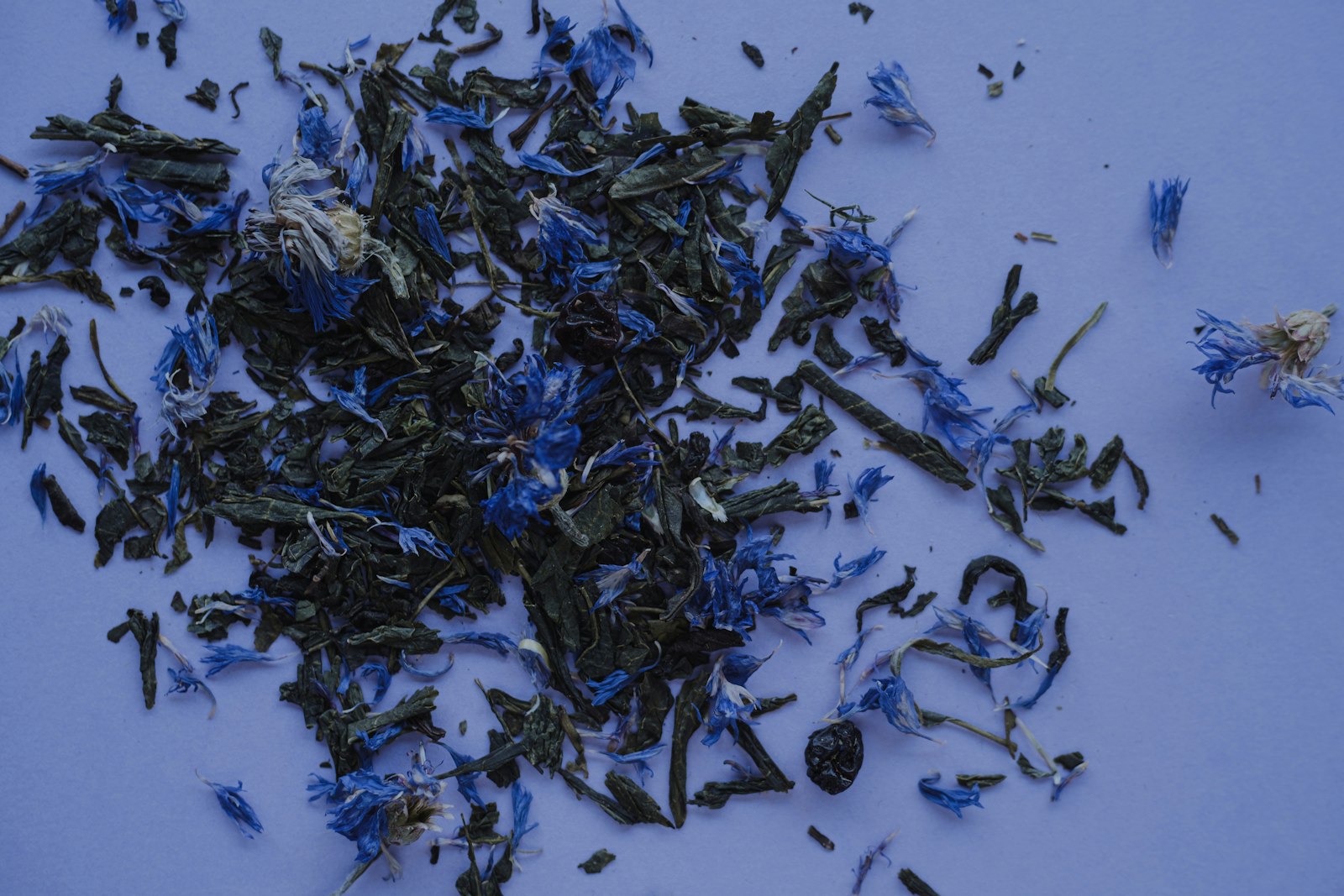
Premium whole-flower grade should be deep, saturated blue across the batch — the blue pigment in butterfly pea comes from a family of polyacylated anthocyanins called ternatins, specifically polyacylated delphinidin-3,3′,5′-triglucosides. Their concentration and stability is directly tied to how the flowers were dried. Open the bag and lay a small handful on a white surface under natural light. Look for:
- Uniform deep blue. Variation within normal; gross patchwork is a red flag.
- Browning. Any significant proportion of brown or tan flowers signals over-hot drying, sun damage, or oxidation during storage. Brown flowers have lost ternatin content. They are worth less and will produce weaker color in use.
- Fading or grey tones. Can indicate old stock, poor storage (high humidity or light exposure), or low initial ternatin content from poor-quality harvest.
A simple pH color test on a pinch of flowers steeped in ambient-temperature water will tell you a lot in under two minutes: the infusion should be clear deep blue at neutral pH and shift visibly to purple and then pink-magenta when you add a few drops of lemon juice or citric acid solution. A faded, muddy, or slow response suggests degraded anthocyanins.
Intact-to-broken ratio
For premium tea and cocktail-visual applications, the proportion of intact whole flowers matters. Premium tea grade is often specified at ≥90% intact flowers — that means at most one in ten flowers showing broken petals, torn calyxes, or reduced to fragments. Weigh out 10 g and sort manually. Count intact versus broken. If you are buying for extract or blend feedstock, the ratio matters less; if you are building a branded loose-leaf tea product where the flower is part of the visual, every broken flower in the retail pouch is a quality complaint waiting to happen.
Foreign matter
Butterfly pea is a climbing vine harvested by hand from smallholder plots across Indonesia and Southeast Asia. Hand-picking is careful work but it is not sterile work. Spread the sample thinly and check for stems and leaf fragments, seed pods, dust and grit, insect parts, and any material that is not flower. A well-processed lot should have minimal foreign matter. A high proportion of stems and fines mixed in with whole flowers suggests the crop was not sorted after harvest — the FOB price may look attractive, but you are paying for weight that adds nothing to your product.
Odor
Open the bag and smell immediately. Good dried butterfly pea flowers have a mild, clean, slightly vegetal note — not strongly aromatic, not offensive. What you are checking against is off-notes:
- Musty, damp, or mold-adjacent odor: the single most important warning sign. Moisture content above the defensible norm (industry practice infers ≤10% for premium, ≤12% for standard grade, based on general dried-herb Codex practice — not a butterfly-pea-specific published standard) creates conditions for mold and mycotoxin development, often invisible at early stages. If it smells off, send it for moisture and mycotoxin testing before you proceed.
- Stale or rancid note: can indicate oxidation from poor packaging or long storage.
- Chemical or solvent odor: raises pesticide or fumigation questions immediately.
Step 4 — Reading the Certificate of Analysis
The CoA is not a rubber stamp. It is only as useful as the lab that issued it and the batch it was drawn from. Here are the fields that matter most for a butterfly pea flower import decision:
- Moisture content (%)
- The most basic quality indicator. Industry practice for dried botanical herbs suggests ≤10% for premium grade and ≤12% for standard grade; these are defensible norms inferred from general Codex/herb-trade practice, not a species-specific published specification. Ask the supplier which figure their internal spec targets. If the CoA shows 13–14% moisture, that is not automatically a rejection, but it requires a conversation about storage and shelf-life.
- Water activity (aW)
- More predictive of microbial risk than moisture percentage alone. A water activity at or below 0.6 is the commonly used threshold for inhibiting most mold growth in dried botanicals. This figure should appear on any serious CoA from a supplier with food-grade systems. If it is absent, ask for it.
- Microbiology panel
- At minimum: Total Plate Count (TPC), yeast and mold count, Salmonella (absent per 25 g), and E. coli (absent per 25 g). Depending on your market and application, you may also require Staphylococcus aureus and Listeria panels. US FDA and EU food hygiene regulations both have microbial limits for herbal products; your destination-market compliance team should confirm what your specific product category requires.
- Pesticide multi-residue screening
- This is where smallholder-sourced material faces the most scrutiny. Butterfly pea grown by uncertified smallholders in Indonesia or elsewhere may carry organophosphate, pyrethroid, or fungicide residues. The CoA should show a multi-residue panel run by LC-MS/MS and GC-MS/MS covering your destination-market Maximum Residue Level (MRL) list — EU MRLs (Regulation 396/2005) are the most stringent globally, though given the current EU novel-food non-authorization, the immediate relevance depends on your market. US EPA tolerances and import alert protocols apply for US-bound shipments. Accept nothing less than a 200+ compound multi-residue screen from a credentialed lab.
- Heavy metals (ICP-MS)
- Lead (Pb), cadmium (Cd), arsenic (As), and mercury (Hg) at minimum, quantified by Inductively Coupled Plasma Mass Spectrometry. Acceptable limits vary by destination market and application — herb-market norms and food-additive regulations differ. Confirm the applicable limits with your broker before evaluating results.
- Anthocyanin color strength / total anthocyanin content
- This is where the CoA connects directly to what you are paying for. Anthocyanin concentration can be measured by spectrophotometric absorbance (typically at the absorbance peak around 560–620 nm for butterfly pea extracts) or quantified by HPLC. Higher is better for color-yield applications. Importantly, this figure — combined with the pH color-response test you ran on the physical sample — gives you a baseline to compare against future production lots. If production CoAs show significantly lower anthocyanin strength than the sample CoA, you have a legitimate basis to reject or renegotiate.
- Mycotoxins (if moisture gives cause for concern)
- Aflatoxins B1, B2, G1, G2 and total aflatoxin, plus ochratoxin A, are the most commonly relevant for dried botanical herbs. EU limits for aflatoxin in herb products are strict. If your physical sample showed any odor flag, request this panel proactively rather than discovering a problem after commercial lots are on water.
The provenance of the lab matters
A CoA from a supplier’s in-house lab carries less weight than one from an accredited third-party. Look for ISO/IEC 17025 accreditation on the laboratory. Recognizable third-party labs operating in Southeast Asia include SGS [VERIFY], Bureau Veritas [VERIFY], Intertek [VERIFY], and various government-affiliated research laboratories — do your own due diligence on current regional operations and accreditation scope. If a supplier cannot name the third-party lab that issued their CoA, or if the CoA was issued by an entity with the same address as the supplier, ask for a retested sample at a named third-party lab before proceeding to commercial volume.
Step 5 — Supplier Audit Signals
A good sample and a clean CoA do not tell you whether the operation behind them is consistent and capable. That requires a supplier audit — either physical (preferred for significant volumes) or documentary (the minimum for any commercial engagement).
Traceability documentation
Ask the supplier to trace the sample batch back through the supply chain. A capable operation should be able to provide:
- Farm or growing area origin (region/district in Indonesia or origin country)
- Harvest date or date range for the batch
- Batch number that links the physical material to the drying and processing records
- Drying method and temperature records where available — the Thai Department of Agriculture, for context, specifies oven-drying at 50–60°C for 8–10 hours for flowers exported from Thailand to Indonesia; this is a single officially documented spec, not a universal industry standard, but it gives a sense of what documented drying process control looks like
Inability to provide farm-level traceability is a significant red flag for any buyer who needs to make food-safety claims, organic claims, or give customs documentation showing country of origin. It is also a signal about operational maturity: processors who can trace a batch can also investigate a problem. Those who cannot trace it cannot help you when something goes wrong.
GMP, HACCP, and ISO 22000 certificates
Request copies of all current food-safety certifications and verify them independently. Good Manufacturing Practice (GMP) certification, HACCP plans, and ISO 22000 (food safety management) are the baseline credentials for any supplier claiming food-grade operations. Check:
- Certificate expiry date — many buyers discover during a documentation audit that a supplier’s ISO certificate lapsed twelve months earlier.
- Certification scope — the certificate should cover the specific product and production activity you are sourcing, not just a head office or a different product line.
- Certification body accreditation — the body issuing the certificate should itself be recognized by an international accreditation network such as IAF (International Accreditation Forum) members.
Consistency between sample and production
This is the problem that trips up buyers who skip trial orders and go straight from sample to FCL. The sample represents one batch — prepared carefully, often by a quality-conscious team member who knows it is going to a prospective customer. A production lot represents the system operating at commercial speed under normal conditions. The two may not match.
Ask the supplier directly: what is their typical batch size? How many batches make up a 500 kg order? Is the sample from the specific lot or a representative composite? Do they hold retention samples from each batch? Answers to these questions tell you more about operational sophistication than any certificate.
Audit reports
If volume justifies it, request the supplier’s most recent third-party audit report — either from a recognized food-safety audit body or from a previous buyer’s inspection. Many contract manufacturers in Indonesia and Thailand have undergone supplier audits for multinational food companies; those audit reports, even with some sections redacted for confidentiality, give you a structured picture of facility condition, documentation practices, and corrective action history. A supplier who refuses to share any audit record for a significant commercial relationship deserves a conversation about why.
Step 6 — From Sample to Trial Order to FCL
A clean sample does not guarantee the production lot. We say this plainly because the operational gap between a carefully prepared sample batch and a commercially scaled production run is real and documented across the Indonesian botanical export trade. The path that protects you looks like this:
| Stage | Typical volume | Purpose | Key output |
|---|---|---|---|
| Paid sample | 100 g – 1 kg | Physical and lab evaluation; supplier document check | Go/no-go on supplier; baseline CoA for comparison |
| Trial order | 20 – 100 kg (indicative, by quote) | Verify consistency at small commercial scale; test customs clearance and logistics chain | Production-lot CoA; customs clearance experience; relationship baseline |
| First FCL | ~3–5 MT (20 ft container, estimated) or ~6–10 MT (40 ft) | Commercial volume; FCL freight economics kick in | Full trade documentation; verified supplier relationship |
Dried butterfly pea flowers are light and bulky — bulk density is estimated around 100–150 kg per cubic metre based on analogous dried herbs, though no butterfly-pea-specific published figure has been confirmed. A container cubes out (fills by volume) well before reaching its weight limit. The estimated 20 ft FCL load of 3–5 MT and 40 ft load of 6–10 MT are indicative figures, not contracted specs, and should be confirmed with your freight forwarder on the specific lot’s packing configuration.
The trial order stage is where buyers who skipped it later wish they had not. It reveals whether the supplier’s production-lot CoA matches the sample CoA; how lead times actually perform rather than how they were quoted; how the supplier handles communication during production; and how the goods clear customs in your market. The trial order is inexpensive insurance.
Ready to plan your sample-to-FCL journey? Contact us on WhatsApp at +62 811 3982 3875 or via our enquiry form and we will match you with a vetted Indonesian partner, coordinate the sample process, and support you through to commercial volume.
How This Desk Operates
We are an independent sourcing and trade-information desk. We are not a manufacturer, plantation, exporter-of-record, or freight forwarder. We curate vetted partners and route qualified RFQs to them. No supplier can pay to change what we publish or how we assess them. If you use our free guidance and proceed with a partner we connect you to, that partner may pay us a referral fee at no extra cost to you. We say this plainly because we think buyers deserve to know how sourcing desks are funded.
Any specific supplier names or certification claims you encounter during your search — including from sources other than this desk — should be treated as [VERIFY]-flagged until you have independently confirmed certificate numbers, accreditation scope, and current operational status. The butterfly pea SERP contains substantial supplier marketing dressed up as neutral guidance. We try to be something different.
FAQs
How much does a butterfly pea flower sample order cost?
Sample pricing is by quote and not publicly listed by any reputable desk or supplier, because it depends on the weight requested, the grade, the supplier’s preparation overhead for small quantities, and the courier cost to your destination. Expect the structure to reflect a small-quantity premium on the material plus actual shipping — not a flat universal rate. Request a quote via our desk, which can facilitate a properly documented paid sample alongside initial CoA and supplier documents, rather than chasing free promotional sachets that tell you little about production quality.
Can I order a butterfly pea flower sample from Indonesia specifically?
Yes. Indonesia is a significant producer of Clitoria ternatea, with growing areas across Java, Bali, and other islands. When you order butterfly pea flower sample Indonesia material through a vetted desk, the key is ensuring the sample comes with genuine batch documentation — farm or region origin, harvest date, lot number, and a CoA from a third-party accredited lab. Indonesian-origin material often offers competitive FOB pricing relative to Thai premium positioning, making it worth evaluating for buyers whose application does not require the brand equity of Thai-origin labeling. Contact us to route an Indonesia-specific sample inquiry.
What is butterfly pea supplier vetting and why does it matter?
Butterfly pea supplier vetting is the structured process of confirming that a supplier’s operational reality — their facility, documentation, certification status, and batch traceability — matches what they present in initial communications. It matters because the market for this flower is global, fragmented, and largely composed of smallholder aggregators with variable quality systems. A supplier may show you a beautiful sample and a photogenic certificate, while their production line has no cold chain, no batch documentation, and a lapsed food-safety audit. Vetting involves document verification (certificates checked against issuing body records), physical or documentary audit where volume justifies it, and a trial order before any FCL commitment. This desk pre-screens partners for documentation standards, but buyers should conduct their own verification appropriate to their volume and risk.
Does a good sample guarantee the production lot will match?
No. A sample is drawn from a specific batch — often a carefully selected or freshly prepared one. A production lot, especially a large one aggregated across multiple drying batches, may vary in color depth, moisture, and anthocyanin content. The CoA from a sample gives you a baseline; requesting a production CoA from the same third-party lab before you authorize shipment, and insisting on retention samples held by the supplier, gives you the ability to compare and reject if there is a material discrepancy. This is why a trial order — a small commercial volume with full production documentation — is prudent before committing to an FCL.
Should EU buyers sample butterfly pea flower for a food product?
Clitoria ternatea as a food or food ingredient is currently not authorized in the European Union. EFSA raised safety objections (EFSA EN-7084), the Commission terminated the authorization procedure (C(2026)776), and there have been RASFF enforcement notifications and reported recalls in Belgium and Austria. This is not a gray area — marketing butterfly pea as EU food is currently illegal and carries real enforcement risk. If you are an EU-based buyer exploring the ingredient for R&D, cosmetics, or supplement applications (which may be subject to different rules depending on member state), you must take qualified legal and regulatory advice specific to your use case before importing any quantity. This desk cannot advise on EU regulatory compliance; we can route your sourcing inquiry to a vetted partner once your legal position is clear.