Independent sourcing note: We are an independent butterfly pea flower tea B2B sourcing desk — we curate verified Indonesian growers and tea makers and route your RFQ to a vetted partner; we are not the manufacturer, exporter of record, or freight forwarder. Butterfly pea is dried Clitoria ternatea flowers, graded by colour and moisture and also sold as petals, powder, and extract. Figures (MOQ, FOB per kg, lead times) are indicative ranges and vary by grade, season, and volume — final terms are by quote. Compliance (pesticide-residue limits, organic certification, food-contact, and import status such as EU novel-food, which is uncertain) is your responsibility to verify with the supplier and a licensed customs broker — this is general trade information, not legal or regulatory advice. We may earn a sourcing commission on referred orders (referral disclosure).
Butterfly pea powder wholesale refers to the bulk trade of milled, dried Clitoria ternatea flower material — ground to a fine mesh from the same whole blue flowers used in loose-leaf tea, then sold by the kilogram to ingredient buyers who need a dispersible colorant or formulation-ready powder rather than intact petals. It is a distinct product from whole-flower wholesale, and it is distinct again from spray-dried or liquid extract. Knowing which form you actually need before you request a quote will save you money, reformulation headaches, and at least one wasted sample round.
This page draws on the same grounded fact base that runs through every section of this desk. Prices are by-quote ranges — we do not publish a firm number because no honest B2B price board exists for this ingredient, and single public listings are unreliable (more on that below). No maker name appears here unless we have verified them. This is trade information, not regulatory advice; you confirm compliance with your own broker and the relevant authorities.
What Butterfly Pea Powder Actually Is
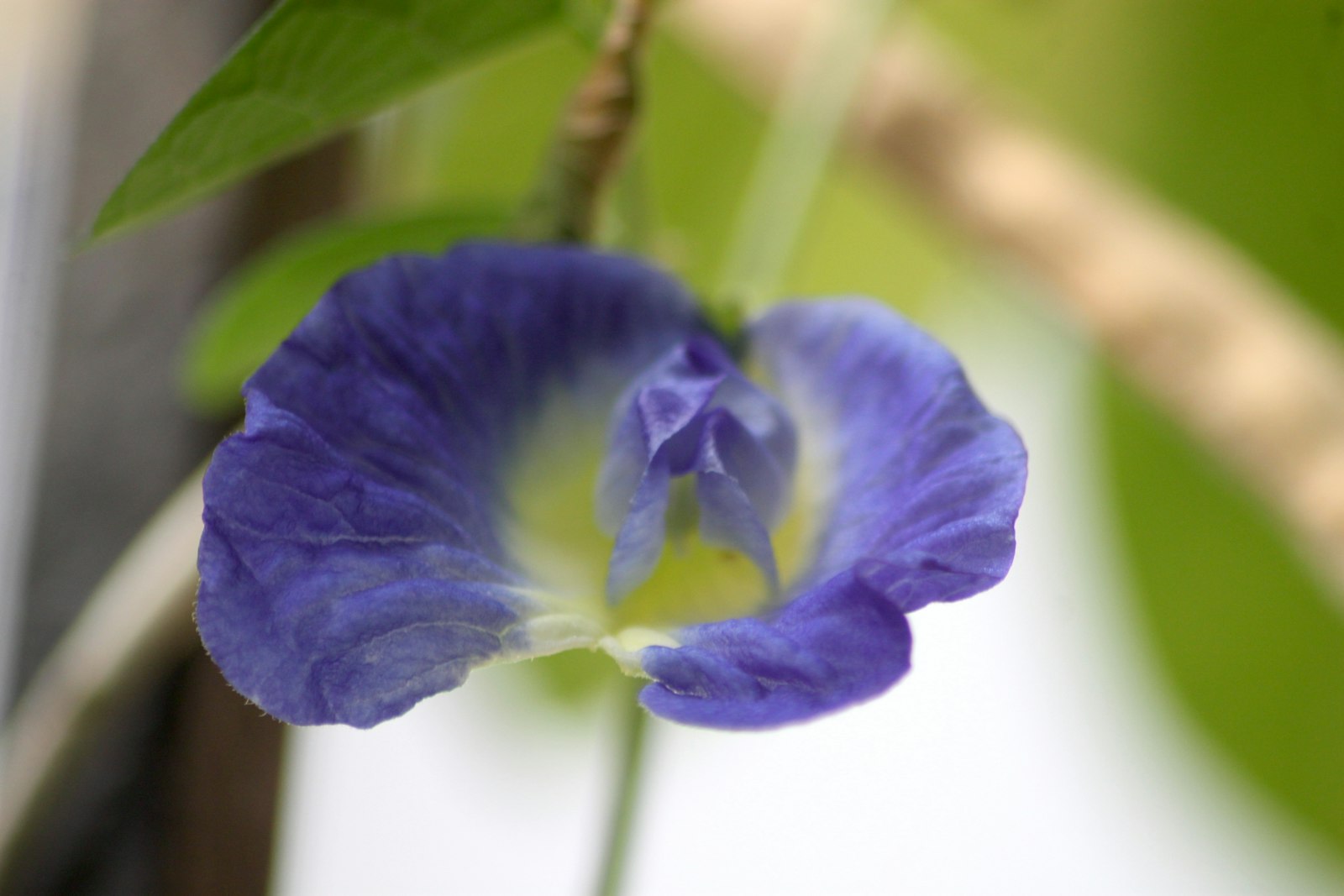
The powder form starts with the same dried Clitoria ternatea flowers that go into premium loose-leaf tea — whole pea-shaped blooms, roughly 5 cm across, picked fully open and dried to a low moisture level. At the milling stage, the dried flowers are ground through a mechanical process until the material passes a target mesh or sieve size. That mesh size is not cosmetic. A coarser grind (say 60–80 mesh) retains more fiber but may not disperse evenly in cold liquids. A finer grind (100 mesh and above) dissolves faster and gives more consistent color per gram in aqueous applications, though it also increases surface area and thus oxidation risk if stored poorly.
The pigment responsible for the blue color is a class of anthocyanins called ternatins — specifically polyacylated delphinidin-3,3′,5′-triglucosides. These compounds are pH-sensitive: blue in neutral or mildly acidic water, shifting to purple and then pink or red as acidity increases. That behavior is exactly what mixologists and beverage developers exploit. It also means the powder retains its color-change function, just in a more concentrated, measured-dose format than whole flowers.
What the powder form does not give you is visual drama. Whole flowers floating in a cocktail glass or infusing in hot water are a selling point in their own right — the intact petal is the experience. Once you grind to powder, that visual element disappears. The powder is a working ingredient, not a garnish.
Powder vs Extract: Choosing the Right Form
Before requesting a quote from any blue pea powder bulk supplier, be clear about which form your application actually demands. The market conflates these two categories constantly, and the confusion leads buyers to source the wrong product and then reformulate expensively.
Ground Flower Powder
Ground flower powder is exactly what it sounds like: dried whole flowers reduced to a fine mesh. It retains all the fiber, plant cell material, and naturally occurring compounds present in the flower, including the ternatins. The color yield per gram depends directly on the original anthocyanin concentration of the dried flower feedstock — which is itself a function of drying temperature, oxygen exposure, light, and time in storage. A well-dried, freshly milled powder from good feedstock can deliver deep blue color at relatively low doses in a beverage. A powder milled from over-dried or light-damaged flowers will be brownish and visually dull before you even open the bag.
Common applications: blue latte mixes, tea blends in powdered format, dry spice blends, confectionery coatings, capsule filling for nutraceutical products. Mesh size needs to be specified when ordering.
Spray-Dried Butterfly Pea Extract
Spray-dried butterfly pea powder is a different product, even though it may arrive in the same bag format. Here, the flowers are first extracted in water (hot or cold infusion), the resulting liquid is filtered and concentrated, and the concentrated extract is then atomized and dried rapidly in a spray chamber — typically with a carrier such as maltodextrin — to produce a fine, free-flowing powder. The result is a water-soluble butterfly pea extract with a higher color concentration per gram than ground flower powder, more consistent dose-response behavior, and much lower fiber content.
For beverage colorant applications — RTD (ready-to-drink) beverages, flavored waters, lemonade-style drinks that exploit the pH color shift, cocktail syrups — spray-dried extract is usually the more economical choice on a cost-per-color-unit basis, even if the headline per-kilogram price is higher. The higher concentration means you use less per liter of finished product. This matters when you are running a production line at scale.
Liquid extracts also exist: the same water extraction process without the spray-drying step. Liquid concentrates are used in some RTD and syrup applications where water activity and microbial stability can be managed, but they complicate transport and shelf life, so spray-dried dominates international trade.
Quick Comparison
| Attribute | Ground flower powder | Spray-dried water-soluble extract |
|---|---|---|
| Feedstock | Dried whole flowers, milled | Water extract of dried flowers, spray-dried with carrier |
| Color concentration | Moderate; tied to feedstock anthocyanin level | Higher; standardizable to target absorbance |
| Fiber content | High (full plant matrix) | Low to negligible |
| Dispersibility in water | Mesh-dependent; may need agitation or blending | Good to excellent (designed for dissolution) |
| Typical applications | Blue latte, capsule fill, dry spice blend, confectionery | RTD beverage colorant, cocktail syrup, dairy coloring, baking |
| Cost-per-kg | Lower headline price | Higher headline price, lower cost-per-color-unit at scale |
| US regulatory status | Treated as conventional herbal/food ingredient (no FDA color-additive approval for powder form); avoid disease claims | Water extract approved as color additive exempt from certification, 21 CFR 73.69 [VERIFY current approved categories] |
| EU status | Novel food — NOT authorized for food use in the EU; enforcement active | Same novel-food non-authorization applies; water-extract approval does not transfer to EU |
Why Whole Flower Is Not the Default for Colorant Buyers
A buyer coming from the tea trade sometimes defaults to whole flowers for everything. It is a reasonable instinct — whole flowers are the premium form, they are recognizable, they photograph well. For a colorant application at manufacturing scale, though, whole flowers create practical problems that powder or extract do not.
Whole flowers need to steep in hot water and then be filtered out before the infusion is usable as a colorant. In a tea bag or a cocktail glass, that filtration step is the product experience. In a manufacturing line, it is a processing cost, a filtration waste stream, and a variable you have to control batch to batch. Powder dispersed directly into a batter, frosting, or latte base eliminates the infusion and filtration steps. Spray-dried extract dissolved directly in liquid eliminates them even more cleanly and lets you hit a color target with a calibrated dose.
Cost-per-color-unit thinking — not per-kilogram price — is the correct frame for colorant procurement. A whole flower lot at USD 8/kg that requires infusion, filtration, and variable yield may work out more expensive per liter of finished colored liquid than a powder at USD 10/kg or an extract at USD 25/kg that doses cleanly. The numbers here are indicative illustrations, not firm quotes; the calculation only works with the actual color-yield data from a specific lot, which a reputable supplier’s CoA should provide as absorbance at the relevant wavelength (approximately 560–620 nm for the blue ternatin pigments).
Packaging Norms for Powder and Extract (Indicative)
Dried flower powder is typically exported in double-layer LDPE (low-density polyethylene) bags, which provide a moisture barrier and some light protection. Pack sizes up to roughly 20 kg per bag are common in the trade — though this is an industry-norm observation and not a fixed spec. [VERIFY with your specific supplier; pack sizes vary by processor and order volume.]
The rationale for double-layer packaging matters to the buyer: ternatin anthocyanins degrade with moisture, oxygen, and light. A single thin poly bag that gets a small hole during transit or warehousing can mean the entire pack loses color before it reaches your production line. Outer cartons add mechanical protection. For spray-dried extract, some processors use foil-lined bags or additional desiccant packs given the hygroscopic nature of the maltodextrin carrier; ask specifically about this when sourcing extract.
Shelf life is typically stated by suppliers as 18–24 months from production date, stored cool, dark, and dry. This is a supplier-stated and general-herb norm rather than a peer-reviewed butterfly-pea-specific figure; treat it as a contract reference point and confirm the shelf life on the CoA for each lot. A common contract clause specifies a minimum of 24 months remaining shelf life at point of shipment — reasonable to request if you are buying container volumes.
US Regulatory Context: The Color-Additive Distinction
This section matters specifically for buyers supplying the US food and beverage market. It is trade information, not legal or regulatory advice; confirm current requirements with your regulatory counsel or the relevant authority.
In 2021, the US FDA approved butterfly pea flower water extract as a color additive exempt from certification under 21 CFR 73.69. This is a meaningful regulatory event for extract buyers: it means water-soluble butterfly pea extract can be used as a color additive in approved food categories without the batch-by-batch certification process that applies to some other color additives. The approved food categories have been expanded over time from the initial approval to include beverages, yogurt, candy, pretzels, dairy drinks, ready-to-eat chicken, and others — but you should confirm the exact current list of approved categories in 21 CFR 73.69 directly, as the source text was not directly verified at the time of writing and the CFR is amended periodically. [VERIFY]
Three clarifications for buyers who read that approval and assume it covers everything:
- It covers water extract, not whole powder. Ground flower powder is not the same material as the water extract defined in 21 CFR 73.69. If you are formulating in a regulated food category and relying on that color-additive exemption, the extract form is what the approval describes. Using ground flower powder as a colorant in those same categories may put you in a different regulatory position. Check with your counsel.
- It is a color additive approval, not a health claim permission. Butterfly pea flower has attracted a great deal of health-benefit marketing copy — antioxidant activity, cognitive support claims, and worse. The FDA color-additive approval does not authorize any of those claims. Avoid disease or health claims in finished product labeling.
- It does not affect other import requirements. FDA Prior Notice (required under the Bioterrorism Act for all imported food), FSMA/FSVP supplier verification, facility registration, and pesticide tolerance compliance all still apply regardless of the color-additive status.
For the dried flower and ground powder used in herbal tisane or nutraceutical applications rather than as a colorant, there is no equivalent formal color-additive approval — the product relies on conventional food or dietary supplement status combined with a history of use. That is a workable regulatory path for many buyers, but one that should be confirmed with your own regulatory team, not assumed.
Ready to discuss your specific application and get a live quote? Submit our enquiry form or reach us directly on WhatsApp at +62 811 3941 4563.
EU Buyers: A Firm Warning Before You Order
Clitoria ternatea in foods — including powder and extract intended for food or beverage use — is classified as a novel food and is currently NOT authorized in the European Union. This applies to all forms: whole flower, ground powder, and water extract alike. The EU novel-food framework does not distinguish between them on the question of authorization.
The history of the authorization attempt makes this clearer. A traditional-food notification was filed, but EFSA raised safety objections (reference EFSA EN-7084). The European Commission subsequently terminated the authorization procedure (C(2026)776). Active enforcement has followed: RASFF notifications have been filed (including Austria 2025.0444 and Belgium 2024, involving Cambodian-origin flowers), and recall actions have been reported in Belgium. Marketing butterfly pea flower as a food or food ingredient in the EU is currently illegal and carries real enforcement risk.
Supplement use in the EU may be treated differently depending on member state, but the rules are jurisdiction-specific and not settled across the bloc — treat that as uncertain and verify with counsel for each target market. Organic certification does not override the novel-food non-authorization. If you are sourcing powder or extract for EU food or supplement distribution, obtain legal advice on your specific product and market before placing any order.
For buyers in the US, Australia, Japan, South Korea, and other markets where butterfly pea flower has a longer history of commercial food use, the regulatory environment is generally more permissive — but varies. Confirm for your specific destination.
Pricing: What the Market Actually Looks Like
Pricing for butterfly pea powder and extract is not published on any industry price board. Public listings are sparse, often incomplete, and reflect retail or B2C-adjacent pricing rather than true FOB export trade. Here is what we know and what we do not.
For ground flower powder derived from standard food-grade feedstock, indicative FOB price ranges inferred from sparse public data and analogous herb trade suggest a band in the rough vicinity of USD 6–10/kg for non-organic Indonesian or Vietnamese-origin material at meaningful B2B volumes. This range reflects broken-petals and fines feedstock more than premium whole-flower inputs. It is not a firm quote and varies significantly with grade, volume, certification status, and season. Do not use this as a negotiating anchor without a live quote from a verified supplier.
One public listing showing approximately USD 17.9/kg for powder has been noted in trade research. We treat it as a single-source, unverified data point and decline to publish it as a reliable reference. [VERIFY before citing.] It may reflect a premium product, a different market segment, a retail-adjacent channel, or simply an outlier listing. We have seen enough outlier listings in the botanical trade to know they create more confusion than clarity.
Spray-dried water-soluble extract will carry a higher per-kilogram headline price than ground flower powder — the additional extraction and drying processing steps cost money, and the concentration is substantially higher. Whether that higher price is justified depends entirely on your cost-per-color-unit calculation for your specific application. For high-volume RTD beverage production, extract almost always pencils out better. For a small-batch nutraceutical capsule operation, ground powder may be the more practical choice at the volumes involved.
The correct approach: request a live quote, specify your target mesh size or extract concentration, state your volume and destination, and ask for the CoA with absorbance data so you can actually compare color yield across suppliers. Use our enquiry form to start that process, or message us on WhatsApp at +62 811 3941 4563 with your product form, volume, and destination.
What to Specify When Sourcing Powder or Extract
Vague RFQs produce vague quotes. Before you reach out to any butterfly pea flower extract supplier, be ready to answer these questions clearly:
- Product form
- Ground flower powder (specify target mesh size, e.g. 100 mesh) or spray-dried water-soluble extract (specify carrier if you have a preference, typically maltodextrin; specify target anthocyanin concentration if known).
- Grade and origin preference
- Standard food-grade vs organic. Indonesia, Thailand, or Vietnam. Note that organic certification must be verified at source — do not accept supplier claims without documented certification from an accredited body.
- Volume and MOQ
- State your target monthly or annual volume and the minimum order you can commit to for a first trial order. Small wholesale entry points are typically in the 20–50 kg range; serious B2B FOB volumes run 100–500 kg and above. These are indicative, supplier-dependent ranges — your quote will state the specific terms.
- Destination country and port
- This determines applicable import regulations, pesticide MRL thresholds, labeling law, and Incoterm preference.
- Required documentation
- CoA (moisture, micro panel including Salmonella absent/25 g and E. coli, pesticide multi-residue, heavy metals by ICP-MS, color absorbance), phytosanitary certificate, and any organic certificates if relevant. For the US market: supplier must be registered with FDA and covered under your FSMA/FSVP supplier verification program.
- Application context
- Telling a supplier whether you are making RTD beverages, latte mixes, capsules, or confectionery helps them recommend the right form and mesh. It also tells you whether you need to confirm the US 21 CFR 73.69 color-additive approved-category list for your specific product.
Quality Signals: What a Good Lot Looks Like
Powder and extract are harder to evaluate visually than whole flowers, but the quality signals translate. Good ground flower powder should be deep blue-violet in color with no significant grey or brown tones. Brown powder signals over-heated drying of the source flowers, excess light exposure in storage, or advanced oxidation — any of which represents degraded ternatin content. The powder should be free-flowing and fine, not clumped, which points to low moisture and adequate packaging. Any off-odor (musty, fermented, or otherwise unusual) in a dry powder sample is a warning sign for microbial issues or moisture damage.
For spray-dried extract, color is again your starting indicator — a pale, washed-out extract powder suggests either a dilute extraction or carrier-heavy formulation. Clumping in extract powder often signals moisture uptake from the hygroscopic maltodextrin carrier, which means packaging or storage failure.
Beyond visual checks, the CoA is not optional — it is the document you are buying. Key fields to confirm:
- Moisture content: ideally at or below 10% for premium, 12% for standard (inferred from general dried-herb practice, not a butterfly-pea-specific standard — but a defensible benchmark to hold suppliers to)
- Water activity: around 0.6 or below to limit microbial risk
- Microbiology: total plate count, yeast and mold count, Salmonella absent per 25 g, E. coli absent per 25 g
- Pesticide: multi-residue panel (LC/GC-MS/MS) against destination-market MRLs
- Heavy metals: lead, cadmium, arsenic, mercury by ICP-MS
- Color strength: absorbance measurement at the relevant wavelength range (approximately 560–620 nm) — this is the figure that tells you actual color yield per gram
Botanical identity verification matters more than buyers often realize. For powder and extract, the visual check that works for whole flowers is gone. DNA barcoding or HPTLC anthocyanin fingerprinting are the tools that confirm you have Clitoria ternatea rather than a substitute or adulterant — relevant for any high-value or regulated application.
Working with This Desk
We are an independent sourcing desk, not a plantation or exporter-of-record. We curate Indonesian makers and processors, route qualified RFQs to a vetted partner who quotes, contracts, and ships, and we publish trade information to help buyers make sense of a market that is otherwise opaque. Where an introduction results in a transaction, the partner may pay us a referral fee; that does not change what we publish here.
To start a powder or extract inquiry, tell us: ground flower powder or spray-dried extract, target mesh or concentration, volume, destination, and required certifications. We route the RFQ, ask the right questions, and come back with a quote and sample offer from a vetted processor.
Contact us via our enquiry form or WhatsApp at +62 811 3941 4563 or email at [email protected].
Frequently Asked Questions
Is butterfly pea flower powder the same as spray-dried butterfly pea extract?
No. Ground flower powder is milled from dried whole flowers and retains the full plant matrix including fiber. Spray-dried extract is produced by first making a water infusion of the flowers, concentrating it, and drying it with a carrier like maltodextrin — producing a higher-concentration, more water-soluble product with much less fiber. They behave differently in formulation and carry different regulatory designations in the US market. Specify which form you need before requesting a quote.
Does the US FDA color-additive approval for butterfly pea flower cover the powder form?
The 2021 FDA approval under 21 CFR 73.69 covers butterfly pea flower water extract as a color additive exempt from certification — not ground flower powder. If you are relying on that color-additive approval for your finished product’s regulatory status, you need the extract form as defined in the regulation, not mechanically ground powder. Confirm the exact current list of approved food categories in 21 CFR 73.69 with your regulatory counsel, as the CFR is amended over time and the full current scope was not directly verified here. [VERIFY]
Can I import butterfly pea powder into the EU?
Not legally for food or beverage use under current EU rules. Clitoria ternatea is classified as a novel food in the EU and is not authorized for sale as a food or food ingredient. EFSA raised safety objections (EN-7084), the European Commission terminated the authorization procedure (C(2026)776), and RASFF enforcement actions have followed. This applies to all forms including powder and extract. Supplement status differs by member state and is legally uncertain. Before ordering for any EU market — food, supplement, or otherwise — obtain qualified legal advice on your specific product and jurisdiction.
What mesh size should I specify for butterfly pea powder in a blue latte mix?
Most blue latte mix applications work best with a finer grind — 100 mesh and above — to achieve even dispersion in milk or plant-based milk without visible grit or sediment. Coarser grinds (60–80 mesh) can work in applications where the powder is blended aggressively, but the visual result is less consistent and the mouthfeel may be noticeable. Specify your mesh requirement explicitly in the RFQ and request a dissolution test with your target liquid as part of the sample evaluation. Your supplier’s CoA should document the particle size or sieve specification so you can hold future lots to it.
What is a realistic wholesale price range for butterfly pea powder?
We do not publish a firm price for this product because no reliable industry price board exists and public listings are sparse and unreliable. Indicative FOB ranges for ground flower powder at B2B volumes — based on limited public data and analogous herb trade comparisons — suggest a rough band of USD 6–10/kg for standard non-organic material, varying with grade, volume, certification and season. One public listing of approximately USD 17.9/kg for powder exists in trade data but is unverified and single-source; we decline to treat it as a reliable benchmark. [VERIFY before citing.] For spray-dried extract the per-kilogram price is higher, but cost-per-color-unit at scale typically favors extract over ground powder. Request a live quote through our enquiry form or WhatsApp +62 811 3941 4563 for a current, volume-specific figure.