Independent sourcing note: We are an independent butterfly pea flower tea B2B sourcing desk — we curate verified Indonesian growers and tea makers and route your RFQ to a vetted partner; we are not the manufacturer, exporter of record, or freight forwarder. Butterfly pea is dried Clitoria ternatea flowers, graded by colour and moisture and also sold as petals, powder, and extract. Figures (MOQ, FOB per kg, lead times) are indicative ranges and vary by grade, season, and volume — final terms are by quote. Compliance (pesticide-residue limits, organic certification, food-contact, and import status such as EU novel-food, which is uncertain) is your responsibility to verify with the supplier and a licensed customs broker — this is general trade information, not legal or regulatory advice. We may earn a sourcing commission on referred orders (referral disclosure).
Private label butterfly pea tea bags and pouches are finished retail products — tea bags or sealed pouches bearing your brand — that a contract manufacturer produces from Indonesian or Thai Clitoria ternatea flowers, fills and labels to your specification, then ships ready for retail or foodservice distribution. It is a distinct tier of OEM work: you are not buying bulk dried flowers to process yourself; you are commissioning a manufacturer to deliver shelf-ready units under your label. The format choices, minimum order quantities, material decisions and document requirements at this level differ meaningfully from bulk ingredient sourcing, and that is what this guide covers.
This desk is an independent sourcing and trade-information guide. We are not the manufacturer, the exporter-of-record or the packaging supplier. Where we route an RFQ to a vetted partner and a referral fee results, we say so plainly. Everything here is trade information only — labeling, regulatory and customs questions require your own licensed counsel in the destination market.
Two Formats, One Core Decision: Pyramid Bags vs. Flat Sachets
When buyers first approach private label butterfly pea tea bags and pouches, the format conversation usually narrows quickly to one decision: pyramid bag or flat sachet? That choice is not purely cosmetic. It shapes the cut of the flower you need, the color release your customer experiences, and the per-unit cost of your finished product.
Pyramid Tea Bags: Whole Flowers, Visual Appeal, Premium Positioning
Pyramid tea bag butterfly pea OEM production is built around the bag’s geometry. The three-dimensional pyramid gives dried flowers room to expand as they steep, which matters because a butterfly pea flower is not a small, dense ingredient — whole petals are light and bulky and need space to release their ternatins, the polyacylated anthocyanin pigments responsible for the deep blue color and its pH-shift to purple and pink with acid.
Near-whole petals can go directly into pyramid bags without significant cutting. The intact flower structure is visible through the mesh wall of the bag, which is a deliberate brand moment for premium tea positioning: a customer watching a whole blue petal slowly release deep color into water is seeing the product perform. That visual is a marketing asset that justifies a higher retail price point and photographically is far stronger than a finely cut blend in a flat sachet.
The trade-off is material cost and MOQ. Pyramid bags cost more to produce per unit than flat sachets, both because of the bag construction and because running whole-or-near-whole petals requires more careful handling at the filling stage to avoid breakage that would compromise the visual. If your brand story is built on the sensory theater of butterfly pea — the color change, the whole-flower look — the premium is defensible. If your end market is value foodservice or commodity retail, it probably is not.
Flat Sachets: Finer Cut, Faster Infusion, Lower Cost
Flat filter sachets work better for broken petals or finely cut material. The flat geometry limits expansion, so a whole or near-whole petal does not steep efficiently in a flat sachet — the surface area contact between the flower material and the water is lower, and color release is slower and less complete. A cut-and-sift specification — petals broken to a defined particle size — solves this by increasing contact surface at the expense of visual presentation.
The cut-and-sift decision is not just about sachet compatibility. Finer cuts release color faster, which matters for foodservice buyers whose customers are not watching a slow steep but want color in the cup in under two minutes. The trade-off is that finer cuts also release more fines (dust) into the brew, which can affect the cup’s appearance differently than the clean blue of a whole-petal infusion.
For blended products — butterfly pea plus lemongrass, or butterfly pea with dried lemon peel to trigger the color change in-bag — flat sachets are often the right choice. Blend uniformity is easier to maintain with consistent particle sizes across the mixed ingredients than with a combination of whole butterfly pea petals and finely cut lemongrass.
| Factor | Pyramid Bag | Flat Sachet |
|---|---|---|
| Recommended flower cut | Whole or near-whole petals | Cut-and-sift / broken petals / blends |
| Color release speed | Slower (whole petal structure); vivid when complete | Faster (higher surface area from cut material) |
| Visual appeal of bag | High — whole flowers visible through mesh; brand moment | Low — opaque filter paper, no visibility |
| Per-unit cost | Higher — bag construction, careful filling | Lower — simpler construction, faster line speed |
| Best for | Premium retail, D2C, gift, hospitality amenity | Value retail, foodservice, blend SKUs |
| Blend compatibility | Moderate — mixed particle sizes work against whole-petal look | Good — uniform cut across blend ingredients |
Stand-Up Pouches: Matching the Container to the Ingredient’s Sensitivity
Beyond the tea bag format, the outer retail packaging for loose-flower products — and the secondary packaging that wraps individually tagged tea bags into a retail carton or pouch — needs to address one problem that overrides aesthetics: ternatins are photosensitive, oxygen-reactive anthocyanins. A stand-up pouch butterfly pea product that looks great on the shelf but uses clear or low-barrier packaging is chemically degrading the ingredient while it sits there.
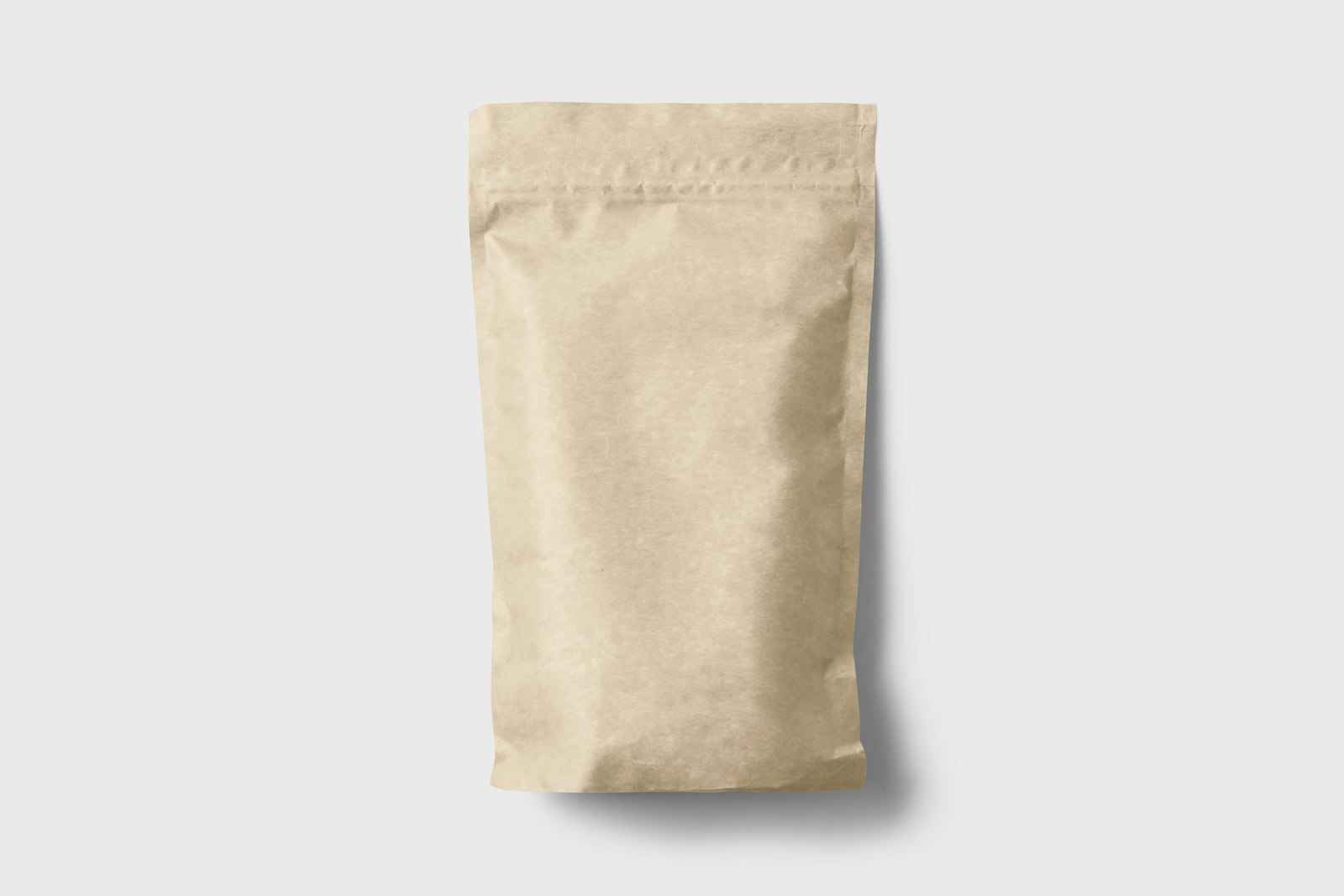
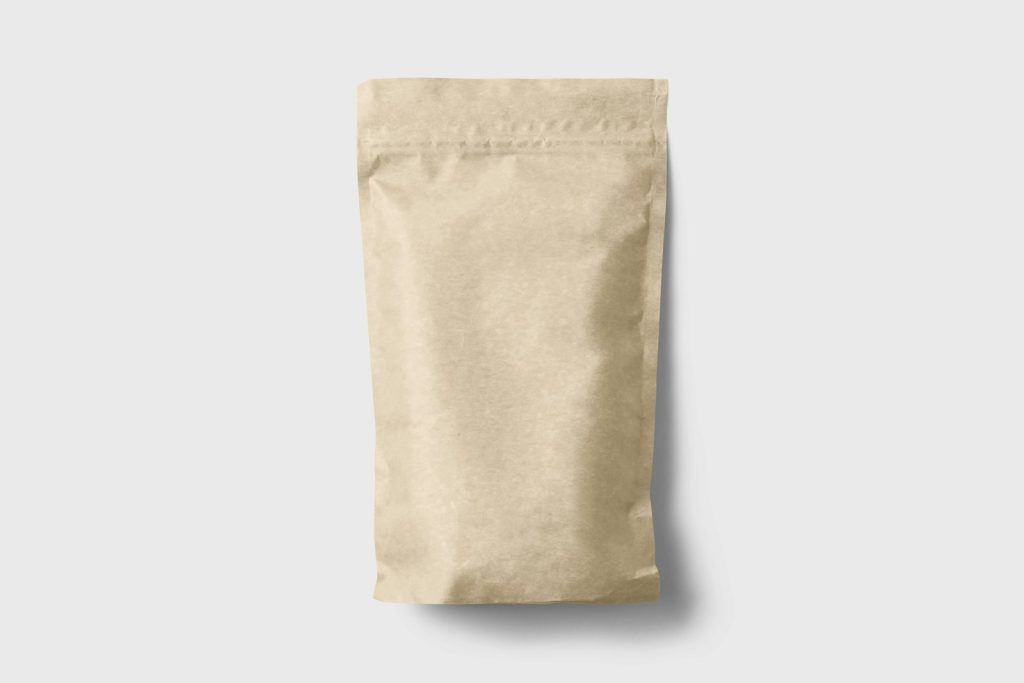
The stand-up kraft pouch with a resealable zip-lock is the dominant format for loose butterfly pea flower tea at the specialty retail level, and it works well when the material specification is right. A kraft exterior is opaque (critical for light protection), resealable zip means oxygen exposure is reduced after the consumer opens it, and matte or kraft surfaces take label printing well. What matters beyond the outer appearance is the laminate stack inside: a plain PE inner layer is adequate for short shelf periods in climate-controlled retail, but for product that will transit through warm humid export routes or sit in a warehouse before reaching retail, a foil-laminate construction — PET/AL/PE or OPP/AL/PE — provides meaningfully better oxygen and moisture-barrier performance.
Ask any manufacturer for the pouch structure specification, not just a photograph. “Kraft stand-up pouch” describes what the buyer sees; it does not tell you whether the barrier performance is adequate for your supply chain conditions and your stated shelf life.
Biodegradable and Compostability Claims: Reading Past the Label
The biodegradable tea bag butterfly pea market is growing because brands want the sustainability story. The material choices are real, but the claims deserve scrutiny before you build a brand position on them.
Nylon pyramid bags are structurally strong, widely used, and cost-effective — but they are not biodegradable, and they have been the subject of microplastic concerns regarding particles released into hot water. If your brand is positioned around clean-label or environmental credentials, nylon creates a direct contradiction.
PLA (polylactic acid, typically corn-derived) is marketed as compostable. That is technically correct under specific conditions: industrial composting at temperatures above roughly 58°C sustained over several weeks. Most consumers disposing of a tea bag at home are not doing that. The “compostable” claim is accurate, but the conditions required for it to be true are not available to most users. If your end market is environmentally sophisticated — and in premium tea retail, it often is — this distinction will come up. Know it before your customer does.
Non-woven biodegradable fabrics made from plant fiber or wood-pulp materials offer more genuinely home-compostable options, with third-party certification available (TUV Austria OK compost HOME, or equivalent in your market). Performance and availability vary by supplier; this is a capability that must be confirmed with your specific manufacturer rather than assumed [VERIFY with each partner]. The certification for the bag material should come from the bag supplier, not be claimed by the tea manufacturer who is simply using the bag.
Blends: Butterfly Pea Plus Lemongrass and the Color-Change Trigger
The most commercially tested blend pairing is butterfly pea plus lemongrass. Lemongrass adds flavor and aroma body that the flower alone lacks — butterfly pea on its own is mild and slightly earthy, which works for some buyers but limits the sensory proposition for mainstream tea consumers. The combination is standard in Thai-origin retail herbal teas and appears widely in Southeast Asian export blend catalogs.
The more interesting formulation for cocktail and mixology buyers is adding a lemon acid source — dried lemon peel, lemon myrtle, or citric acid — directly into the blend sachet. This triggers the pH-color shift in-bag: the brew starts blue and shifts toward purple and then pink as the acid from the blend ingredient releases. For a café, bar or hotel amenity context, a single bag that visually transforms in the cup without any separate customer action is a stronger product moment than handing someone a bag and a lemon wedge separately.
Blends complicate the sourcing and compliance picture. Every ingredient needs its own documentation chain: a separate CoA for the lemongrass, a separate pesticide screen for the lemon peel. A manufacturer who provides a single CoA covering the finished blend without ingredient-level testing is not giving you adequate coverage. Push for ingredient-level documentation even if it requires a separate request.
Ready to spec a blend or format for your first private label run? Outline your format, blend intent and target volume through our enquiry form, and we will route the project to our vetted manufacturing partner for a real proposal. You can also reach the desk directly on WhatsApp at +62 811 3982 4563 or at [email protected].
MOQ Realities Per SKU: Ranges, Not Promises
Minimum order quantities for private label butterfly pea tea bags and pouches are not standardized across the industry. They reflect the manufacturer’s batching economics, their packaging supplier minimums (particularly for custom-printed materials), and the format complexity. What follows is indicative industry practice derived from public OEM tea listings and general herb-trade norms — treat these as planning figures, not commitments [VERIFY with live quote from your specific partner].
- Pyramid tea bags, custom label
- Indicatively 1,000–5,000 units per SKU for retail production [VERIFY]. The lower end of that range is more likely with stock-format bag material; if the bag mesh itself is custom-printed or custom-colored, the minimum often rises to reflect the packaging supplier’s print run. Count per SKU matters: five SKUs at 1,000 units is a different conversation from one SKU at 5,000.
- Flat filter sachets, custom label
- Often somewhat lower than pyramid bags — indicatively 500–2,000 units per SKU [VERIFY] — because the simpler bag construction has less packaging overhead per run. Blend SKUs may carry higher minimums if each ingredient in the blend must hit its own sourcing minimum.
- Stand-up pouches, loose-flower fill
- Indicatively 500–2,000 retail units per SKU, higher if the pouch structure is custom-laminated or custom-printed rather than stock [VERIFY]. A stock kraft pouch with a custom label sticker can lower the entry point meaningfully versus a fully printed custom pouch with a foil laminate structure ordered from a packaging supplier.
- Retail tins, glass jars
- Often 500–1,000 units per SKU at minimum [VERIFY], with tin MOQs sometimes driven by the tinplate manufacturer rather than the tea filler. These formats cost more per unit than pouches and are typically used for premium gift or hospitality positioning where the per-unit economics can absorb it.
- Bulk ingredient for internal filling (50–100 kg flower component)
- Buyers who want to do their own retail filling of bags or pouches typically start with 50–100 kg of dried flower per order [consistent with public listing data — VERIFY]. This is the raw-material tier: you receive dried flowers in export packaging and manage the retail filling process yourself.
The [VERIFY] tags are not disclaimers for legal protection — they are an honest signal that these numbers come from indicative sources and that your specific partner’s actual minimum may differ. A manufacturer’s current capacity utilization, packaging supplier lead times, and whether your SKU matches their existing line setup all affect what the real MOQ ends up being. A live quote is the only number that matters for a real order.
Anthocyanin Sensitivity and Packaging Barrier Requirements
The chemistry of butterfly pea color is the specification driver for every packaging material decision in this product category. Ternatins — the polyacylated delphinidin-3,3′,5′-triglucoside anthocyanins responsible for the vivid blue — are sensitive to three stressors: light (UV and visible spectrum both drive photooxidation), oxygen (direct oxidation of the anthocyanin ring structure), and moisture (both as a direct quality risk through mold and mycotoxin development, and as a catalyst for oxidative degradation).
This means that a decision to use a clear nylon pyramid bag for visual retail appeal has a countervailing quality cost: every unit sitting on a lit retail shelf is accumulating light-driven color degradation. The solution most brands at the premium end adopt is outer carton or retail display packaging that blocks light, even if the individual bag is transparent for the consumer use moment (steeping in a lit kitchen is temporary; sitting on a shelf under fluorescent light for months is not).
For pouches, the barrier specification should reflect your expected supply chain dwell time. Product moving quickly through a well-controlled distribution system can tolerate a lower-barrier pouch than product sitting in a third-party warehouse for months. Shelf life stated as 18–24 months from production is the common supplier figure [supplier-stated and herb-trade norm, not peer-reviewed for butterfly pea specifically — FLAG]. That number is achievable with the right packaging and storage conditions; it is not a given. Build the barrier requirement into your purchase specification and get the manufacturer to confirm in writing that the specific pouch construction they are using meets it.
Documents to Request From Your Contract Manufacturer
No matter how good the samples look, a private label butterfly pea tea bags and pouches order without adequate documentation is a liability. These are the documents a serious buyer requests before committing any deposit — and a manufacturer who cannot or will not provide them before contract signature is telling you something important about how they operate.
Certificate of Analysis (CoA) — Lot-Specific, Third-Party Lab
The CoA must cover the specific production lot being shipped, issued by an accredited third-party laboratory, not an in-house quality department. Minimum required parameters: moisture content and water activity; total plate count (TPC); yeast and mold counts; pathogen absence (Salmonella and E. coli absent per 25 g); heavy metals panel by ICP-MS (lead, cadmium, arsenic and mercury at minimum); multi-residue pesticide screen by LC-MS/MS and GC-MS/MS; and anthocyanin color strength by UV-Vis absorbance at approximately 560–620 nm. A CoA covering only moisture and TPC is not adequate for cross-border food ingredient supply.
For finished retail tea bags or pouches, the CoA should cover the finished product as filled and sealed, not just the raw flower input. If the manufacturer is blending ingredients, each component should have its own CoA in addition to the finished-blend result.
Microbiology Panel
A full microbiology panel matters specifically because butterfly pea flowers are often processed at smallholder scale with ambient or solar drying. Mold and mycotoxin development is a realistic risk in under-dried or improperly stored product, and early-stage mycotoxin formation is not visible or detectable by smell alone. Request aflatoxin results — not assumed absence — for any lot sourced from smallholder growing regions where controlled-temperature drying at 50–60°C is not confirmed. The micro results must be from the actual production lot, not a historical batch from a previous season presented as representative.
Pesticide and Contaminant Statements
A manufacturer’s written declaration that product is “pesticide-free” or “chemical-free” without an accompanying laboratory report is not a compliance document. You need the actual multi-residue screen results showing measured levels against the MRL standards of your destination market. For US buyers, EPA pesticide tolerances for herbal tea ingredients apply. For EU buyers — to the extent any EU food pathway were available, which currently it is not — Regulation 396/2005 MRL requirements would govern. Know your market’s requirements, not just the supplier’s assurances.
Allergen and GMO Declaration
Clitoria ternatea is a member of the Fabaceae (legume) family. Buyers targeting markets with legume allergen labeling obligations — and the US and EU both have allergen declaration frameworks worth understanding in detail for your specific product — should raise this with their regulatory counsel before finalizing label copy. The GMO declaration is relevant to buyers working toward USDA organic or non-GMO project verification, where the chain-of-custody documentation requirement extends to the ingredient level.
HACCP and ISO 22000 Certificates
A manufacturer with a current HACCP plan and ISO 22000 certification has systematically mapped their food-safety hazard control points and has had that system third-party assessed. It is a meaningful filter, not a guarantee: audits have finite scope, renewal cycles vary, and certification documents can be forged. Request the certificate, note the issuing body, and for large orders, consider verifying the certificate number directly with the certifying body before finalizing terms. Manufacturers who claim certification but cannot produce the certificate before you sign a contract are providing useful information about their relationship with documentation.
Organic Certificate Chain (Where Applicable)
If your label will carry USDA NOP or EU 2018/848 organic claims, every handler in the chain from farm to finished retail unit must hold a valid certificate from a recognized accrediting body. Request the full certificate chain: the farm-level certificate, the processing facility certificate, and the filling facility certificate if these are separate operations. “Organically grown” at the farm level does not automatically produce a certifiably organic finished tea bag if the filling facility is not within a certified operation. Chain-of-custody is not optional for organic claims — it is definitional.
EU Buyers: The Novel-Food Wall This Guide Cannot Help You Past
This cannot be buried in a footnote. If you are sourcing private label butterfly pea tea bags or pouches for sale into EU food markets, the fundamental regulatory situation is not a labeling question or a packaging question — it is a product-authorization question with a currently negative answer.
Clitoria ternatea as a food ingredient (distinct from supplements, which vary by member state) is classified as a novel food in the EU and is NOT currently authorized. EFSA raised safety objections (EFSA EN-7084). The European Commission terminated the authorization procedure (C(2026)776). RASFF enforcement notifications have been active: Austria 2025.0444, Belgium 2024, with reported market withdrawals of butterfly pea tea products. Marketing butterfly pea flower tea as a food in EU retail under current rules carries real enforcement risk, regardless of how the packaging is structured or how the label reads.
Supplement rules vary by EU member state and the situation is uncertain — if you have a specific supplement product and jurisdiction in mind, that question requires its own legal assessment from qualified regulatory counsel in the relevant member state. This desk can route your RFQ to a manufacturing partner; it cannot navigate EU novel-food law on your behalf. Verify current status before committing any production budget to an EU food launch.
Label Copy and Health Claims: Where This Desk Stops
A private label tea bag or pouch needs label copy your counsel has reviewed, not label copy generated from a sourcing guide. The standard elements every market requires — common name, botanical name (Clitoria ternatea), ingredient list in descending weight order, net weight in destination-market units, country of origin, responsible party name and address, storage instructions, and best-before date — are not disputed territory. Health claims are.
Butterfly pea has genuine research interest around antioxidant activity. That research is real; it is also not a basis for regulatory-compliant health claims in most markets without additional substantiation that very few private-label tea brands have done. “Supports healthy aging” on a US label requires structure/function substantiation and a specific disclaimer under FDA rules. “Natural antioxidant” sits in different regulatory territory in different markets. Disease claims — anything that implies the product treats, cures, or prevents a medical condition — convert your tea into a drug under most major regulatory frameworks, which has severe consequences for market access. Get every claim in your label copy reviewed by a licensed regulatory attorney in your destination market before finalizing any artwork. This guide can tell you the questions to ask; it cannot give you the legally defensible answers.
If you use our free guidance and proceed with a partner we introduce, that partner may pay us a referral fee at no extra cost to you. What we publish is not influenced by who pays.
Lead Times: What Realistic Planning Looks Like
The most common way first-time private label buyers lose a product launch slot is underestimating how much time the production process actually requires. These figures are indicative, inferred from herb-trade norms rather than butterfly-pea-specific production data [FLAG], and must be confirmed with the actual manufacturing partner before any schedule is committed.
From existing raw-material stock, plain bulk sacks can move in roughly 1–3 weeks ex-factory. Production-against-order — where the manufacturer sources flowers to your specification, dries, grades, tests and packs them — runs closer to 4–8 weeks. New custom private label retail formats with custom packaging artwork, printed pouches or tea-bag tags add time for artwork approval, packaging procurement and line setup: allow roughly 8–12 weeks from confirmed deposit and approved artwork, and more if the packaging is fully custom-printed rather than stock format with applied labels.
Ocean freight transit from Indonesia’s main export ports — Tanjung Priok in Jakarta, Tanjung Perak in Surabaya — adds roughly 10–20 days to major US West Coast or Northern European ports, plus customs clearance at destination. Build two to three weeks of buffer on any estimate, and do not confirm a retail launch date until the manufacturing partner has confirmed a production schedule in writing after receiving a deposit and approved artwork.
How This Desk Fits Into Your Sourcing Process
Butterfly Pea Tea Wholesale is an independent trade-information and sourcing routing desk. We are not the manufacturer, not the exporter-of-record, and not a freight forwarder. We curate vetted Indonesian contract-manufacturing partners, route your RFQ to the right one for your format and volume, and publish honest trade information grounded in what we can verify. We do not publish specific manufacturer names without verification, and we flag capabilities we have not confirmed as [VERIFY]. That is the editorial line Rina Kusuma runs on everything this desk publishes: tell the buyer what is known, flag what is not, and never let a sale outrun the evidence.
To start an enquiry for private label butterfly pea tea bags, flat sachets, stand-up pouches or blended formats: reach the desk on WhatsApp at +62 811 3982 4563, by email at [email protected], or through our enquiry form. Include your target format, approximate first-order volume per SKU, destination country, required certifications, and whether you have existing packaging artwork. The more specific your brief, the more accurately we can route it.
For the full private-label contract manufacturing picture — including the complete OEM process, additional format options and the regulatory overview — see our Private Label & OEM page. For packaging material specs, barrier requirements and retail format trade-offs at depth, the Packaging & Branding guide covers that territory in full.
Frequently Asked Questions
What is the difference between a pyramid tea bag and a flat sachet for butterfly pea?
Pyramid tea bags are three-dimensional and give whole or near-whole butterfly pea petals room to expand during steeping, producing a visually striking brew and a premium on-shelf presentation. Flat filter sachets use a two-dimensional geometry that works better with cut-and-sift material or blends where uniform particle size matters more than visual appeal. Pyramid bags cost more per unit and are better suited to premium retail and hospitality channels; flat sachets are the practical choice for value retail, foodservice and multi-ingredient blends. The format decision also drives the flower cut you need to specify to your supplier.
Are biodegradable butterfly pea tea bags genuinely compostable at home?
It depends on the material. PLA (polylactic acid) bags are industrially compostable at temperatures above roughly 58°C sustained for several weeks — not conditions available in a standard home compost bin in most climates. Non-woven plant-fiber or wood-pulp bag materials certified to standards such as TUV Austria OK compost HOME are more genuinely home-compostable, but capability varies by supplier and must be confirmed with your specific manufacturer [VERIFY]. If your brand sustainability claim hinges on compostability, request the third-party certification for the specific bag material and match it against the actual disposal conditions your customers have available.
What is the MOQ for private label butterfly pea tea bags in retail units?
MOQs vary by manufacturer, format and packaging type. As an indicative planning figure, OEM pyramid tea bags typically run from 1,000 to 5,000 retail units per SKU; flat sachets somewhat lower at 500–2,000 units per SKU; stand-up pouches for loose flower typically 500–2,000 units per SKU [all figures indicative from herb-trade norms, VERIFY with live quote]. Bulk ingredient for buyers doing their own filling generally starts at 50–100 kg of dried flower per order [VERIFY]. None of these numbers are commitments — a live quote from the manufacturing partner is required for any firm production planning.
Which compliance documents must I request from a butterfly pea tea bag manufacturer?
At minimum: a lot-specific Certificate of Analysis from an accredited third-party lab covering moisture, water activity, full microbiology (TPC, yeast and mold, Salmonella and E. coli absent per 25 g), heavy metals by ICP-MS, multi-residue pesticide screen, and anthocyanin color strength; written allergen and GMO declarations; and a current HACCP or ISO 22000 certificate. For finished retail tea bags or blended products, request ingredient-level CoAs in addition to the finished-product result. If organic claims are made, the full chain-of-custody organic certificate covering every handler from farm to filled unit. A manufacturer who will not provide these documents before contract signature is not a manufacturer you should order from.
Can EU buyers source private label butterfly pea tea bags for the EU market?
Not for the food market under current rules. Clitoria ternatea in food is a novel food in the EU and the authorization procedure was terminated following EFSA safety objections (EFSA EN-7084; Commission decision C(2026)776). RASFF enforcement is active. Member-state supplement rules vary and are uncertain. Launching butterfly pea tea products in EU food retail channels under current law carries serious enforcement risk regardless of the format — tea bags, pouches or any other. This is not a label question; it is a product-authorization question. Verify current status in your specific jurisdiction with qualified regulatory counsel before committing any production budget to an EU-facing line.