Butterfly pea harvest seasonality describes how the flowering and picking cycle of Clitoria ternatea unfolds across the calendar year, and whether the supply that reaches a buyer is available continuously or in concentrated bursts. The short botanical answer is that in equatorial Indonesia, the plant is capable of flowering across all twelve months. The short commercial answer is that capability and guaranteed supply are not the same thing, and every claim of year-round butterfly pea supply is a statement about one supplier’s stock discipline, not a biological certainty.
This piece covers the actual harvest timing dried blue flower producers work with, the yield realities B2B buyers rarely see published honestly, and the supply-continuity question that determines whether your lead time is one week or eight. The numbers here are practice-based rather than peer-reviewed — I will flag each one where that applies — because the honest position in this trade is that the agronomic data on dedicated butterfly pea flower production is thin, and much of what circulates as fact is grower guidance extrapolated and repeated without original source.
The Butterfly Pea Flowering Cycle: What Botany Tells Us
Clitoria ternatea is a perennial climbing legume. That classification contains the key to understanding why butterfly pea harvest seasonality differs from most herbal crops a Western importer will have experience buying. Chamomile in Germany, lavender in Provence, peppermint in the US Pacific Northwest — these are temperate-zone crops with single concentrated harvest windows tied to photoperiod and temperature. Butterfly pea has no such single window, at least not under the growing conditions where most commercial production occurs.
The species is pantropical, thriving at mean annual temperatures of 19–28°C, with optimal rainfall around 1,500 mm per year and soil pH tolerance across 5.5–8.9 — a very wide band that covers most productive tropical agricultural soils. Under these conditions, with full sun and adequate moisture, the vine is what plant physiologists call a continuous bloomer: individual flower buds initiate, open, and senesce across the year rather than synchronising to a short reproductive window.
Individual butterfly pea flowers are short-lived. A bloom opens fully for roughly one day at peak colour and anthocyanin content, then wilts. That biology is what drives the morning harvest protocol described in more detail on the how it’s grown and dried page: pickers move through plantings every day or every other day, collecting fully open flowers before afternoon heat degrades both the fresh bloom and the picked material.
What “Equatorial” Actually Means for Flowering
Indonesia sits almost exactly across the equator — from roughly 6°N to 11°S — which removes the strong seasonal temperature swings that would trigger a single concentrated flowering flush in a latitude-sensitive species. Java, Bali, Lombok, Flores, parts of Sumatra and Sulawesi all fall within the climate envelope that suits Clitoria ternatea well. A well-managed planting in lowland Java or Flores should produce flowers across the calendar, given sufficient rainfall distribution.
However, “equatorial” does not mean uniform. Indonesia has a monsoonal climate pattern over most of its territory, with a dry season that varies in duration and intensity by region. West Java and Bali experience a pronounced dry season (roughly May–October in normal years). Flores and the eastern islands can have drier periods that extend significantly longer. A vine under water stress reduces flower output — the plant is protecting vegetative tissue rather than investing in reproduction. This is not catastrophic for a perennial with an established root system, but it is real and it shows up in picking volumes.
The butterfly pea flowering cycle in a specific location is therefore a function of local rainfall seasonality, not just latitude. A planting on irrigated land in West Java with water through the dry season will produce more continuously than a rain-fed planting on Flores during a below-average rainfall year. Buyers asking about harvest timing need to ask by region and by that specific grower’s water management — not by country or by botanical species.
Yield: What We Know and What We Do Not
I want to be direct on this point because it is where a lot of sourcing guides fail their readers by filling gaps with invented precision. Published agronomic yield data for dedicated commercial butterfly pea flower production is sparse. The figures that circulate — kg of dried flower per hectare per year — are largely grower-reported estimates from individual farms in Thailand, India, and Indonesia, not derived from controlled replicated trials.
We do not publish a specific yield figure for that reason. What the available grower accounts consistently describe is a crop whose yield is highly sensitive to:
- Picking frequency — flowers left on the vine past peak will not accumulate value; they drop. Regular daily or alternate-day picking maintains yield by preventing senescence of mature buds. Infrequent picking creates waste and misses the quality window.
- Trellis and vine management — a well-trellised vine with regular pruning to stimulate lateral shoot development produces more flower-bearing nodes. An unmanaged sprawling vine uses its growth energy on vegetative spread rather than flower production.
- Water availability during dry periods — as noted above. Irrigation through dry spells maintains output; rain-fed systems tied to the monsoon will have lower-yield months.
- Soil nutrition — the plant fixes atmospheric nitrogen as a legume, so nitrogen supplementation is less critical than in non-legume crops. But phosphorus, potassium and micronutrient management still influence flower output and plant vigour.
- Ecotype and planting density — there are multiple ecotypes in cultivation across Southeast Asia, with differing flower size, colour intensity, and productivity. Planting density interacts with trellis design and airflow around the canopy.
The practical upshot for a buyer: when a supplier quotes you a volume available per month, ask what that is based on. Is it active inventory? Estimated picking from current plantings? A forward commitment against a harvest that has not yet happened? The answer tells you whether you are dealing with a documented supply chain or a hopeful extrapolation.
Seasonality and the “Year-Round Supply” Question
The phrase “year-round butterfly pea supply” appears in many supplier listings, particularly from Indonesian and Thai exporters. It reflects a biological truth: Clitoria ternatea can flower year-round in equatorial climates. But “can flower” and “will supply consistently” are different propositions, and buyers should probe the difference before building a supply chain assumption around it.
Continuous supply from any single origin supplier depends on at least four independent variables:
- Planted area under active management
- A small outgrower network serving a modest exporter may be picking from a few hectares. One bad dry season, one disease pressure event, or one competing buyer claiming the available volume removes the continuity picture entirely.
- Drying and processing capacity
- Even if flowers are being picked daily, a drying facility with limited tray capacity or seasonal labour creates processing bottlenecks. During high-harvest periods, the backlog on the drying floor — which must be managed quickly to prevent fermentation and colour loss — constrains how much material becomes commercially saleable per week.
- Stock strategy
- Some Indonesian exporters run genuine carry-on inventory: dried and packed flowers held in controlled storage to smooth supply across picking-slow months. Others process to order and hold nothing. The exporter with a stock buffer can ship in two weeks any time of year; the produce-to-order exporter may quote four to eight weeks during a lower-flush period.
- Concurrent order load
- A supplier with one large contract can be unavailable to a second buyer for weeks, regardless of harvest timing. Year-round availability is partly a function of how much of their capacity is already committed.
The honest framing is this: Indonesian butterfly pea origin has the biological conditions to support year-round production. Whether a specific supplier can deliver on that across your calendar year is a supplier-specific commercial question, not a botanical guarantee. Test it across multiple order cycles before treating any supplier as a confirmed continuous source.
Seasonality and Price: The Link Buyers Miss
In markets where supply genuinely tightens — a shorter dry season hitting multiple growing regions simultaneously, or a surge in demand from a new application category pulling volume from the available pool — indicative FOB prices for dried butterfly pea flowers can shift upward. The ranges published on our FOB price guide (standard food-grade whole, non-organic: roughly USD 6–12/kg for Indonesian origin; premium and organic selections running higher) reflect normal-market ranges. Tight supply periods that compress available inventory push buyers toward the upper end of those ranges or toward longer lead times while they wait for supply to recover.
Conversely, post-flush periods when suppliers have accumulated more inventory than their current orders absorb are often the best moments to negotiate volume pricing. A supplier with thirty bags of dried flowers in the warehouse and no immediate taker is more flexible than one whose inventory is committed three months forward.
This timing dynamic is real but difficult to predict from a buyer’s position without a close supplier relationship. The practical approach is to maintain a relationship with a vetted source well before you are under delivery pressure, and to sample and approve a supplier during a period when supply is adequate rather than scrambling during a crunch.
Harvest Timing and Dried Flower Quality
Harvest timing — meaning time of day, frequency, and stage of flower development at picking — is one of the two main quality determinants in butterfly pea, the other being drying. The two are connected: a flower picked at the wrong stage or left too long before drying loses anthocyanin content even before it reaches the dryer.
The standard grower practice is to pick flowers fully open, in the early morning, before heat begins to accelerate wilting and pigment degradation. This is practice-based guidance, not the output of controlled trials comparing morning vs. afternoon harvest systematically across replicates. We present it as a defensible norm backed by the underlying chemistry: ternatins, the polyacylated anthocyanin pigments responsible for the blue colour, degrade faster under elevated temperature, oxygen, and UV exposure. Morning harvest into shaded containers, moved quickly to the drying stage, limits all three exposures.
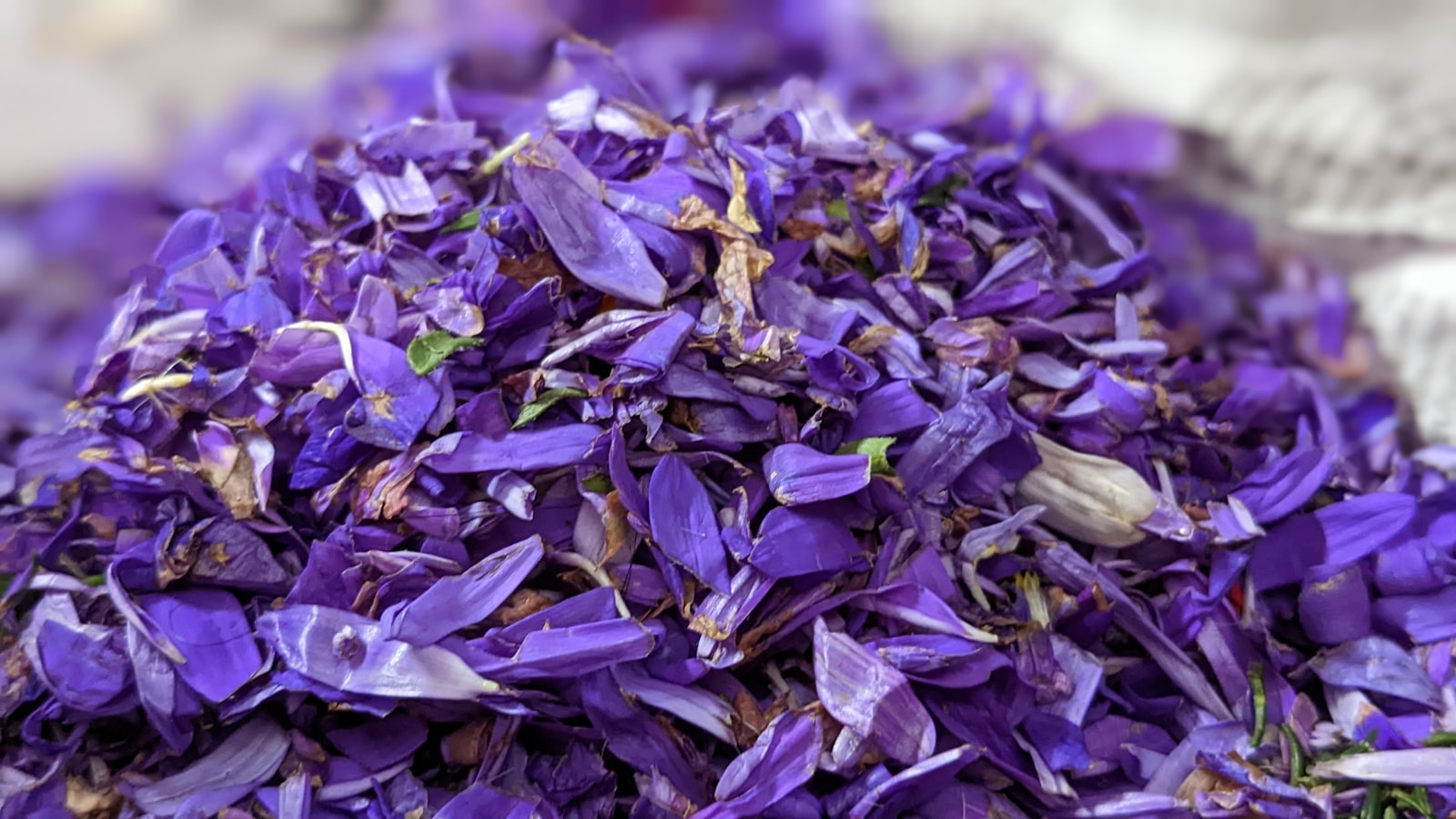
A buyer evaluating harvest timing quality cannot usually visit the farm. What they can interrogate is the proxy signal: colour depth and uniformity on the COA colourimetry data, and on the physical sample. Vivid, uniform deep blue with minimal browning in even a small fraction of the batch is a signal of disciplined harvest timing and rapid post-harvest handling. Brown-tinged flowers in a sample, before any moisture or mould issue is identified, usually indicate either late-in-day picking, slow transfer to drying, or over-hot drying — or some combination of the three.
For a full treatment of drying protocols and how they affect colour retention, the cultivation and drying page covers the temperature specifications and the anthocyanin chemistry in more detail.
How Harvest Seasonality Connects to Lead Times
The practical downstream effect of butterfly pea harvest seasonality shows up most directly in lead times. A supplier quoting from active in-stock inventory — dried, graded, packed, and COA-tested — can move in roughly one to three weeks ex-factory. A supplier who must schedule a production run against your order because current stock is committed or insufficient is working with a four-to-eight-week ex-factory window, with the actual duration depending partly on where in the flowering cycle their plantings sit at the moment you confirm the order.
| Supplier stock situation | Seasonality factor | Indicative ex-factory lead time |
|---|---|---|
| Processed, packaged, COA-tested lot in warehouse | None — stock already exists | ~1–3 weeks (documentation and logistics) |
| Production against order; fields in active flush | Low impact — harvest accumulates quickly | ~4–6 weeks |
| Production against order; dry-season slowdown or recent large pick-up | High impact — picking pace reduced | ~6–10 weeks or more |
| Certified organic lot; must draw from certified-only planted area | Certified area may be smaller; no blending with non-organic | ~6–12 weeks depending on certified volume |
All ranges are indicative and inferred from herb-trade norms. They are planning estimates, not contractual commitments. A live quote from a vetted exporter will state the actual schedule for your order.
For a full breakdown of lead-time components — including COA lab turnaround, phytosanitary documentation, ocean transit, and how payment timing affects when production actually starts — see the lead times and production planning page.
Sourcing Implications: What a Careful Buyer Should Do
The seasonality and yield picture described above translates into a few concrete sourcing practices worth building into your process before you commit to volume.
Ask about the stock position at the time of inquiry, not in the abstract. “Do you have stock available?” and “When could you ship 500 kg?” are the questions that reveal the actual supply situation. A supplier who can answer the second question with a date and an explanation of whether that is from existing stock or a new production run is telling you far more than one who simply asserts year-round availability.
Request the COA issue date on any proposed lot. A COA issued in the last few weeks confirms the lot is genuinely processed and tested. A COA from eight months ago, re-offered for a new buyer inquiry, should prompt questions about how the lot has been stored in the interim and whether remaining shelf life covers your needs. Shelf life for properly dried, airtight-stored butterfly pea flowers is widely stated at 18–24 months from production — a practice-based commercial norm, not a peer-reviewed figure — which means an old lot is not automatically unusable, but the remaining window narrows.
Build seasonal buffer into your procurement calendar. If you have a known demand peak — a product launch, a promotional window, a retail seasonal peak — plan your butterfly pea flower order to arrive with at least three months’ stock on hand. That buffer absorbs a dry-season slowdown, a lab COA delay, or a vessel scheduling gap without forcing an emergency reorder.
Qualify more than one supplier before you depend on a single source. This is not a counsel of excessive caution; it is standard supply chain practice for any speciality botanical ingredient. Two vetted sources in different growing regions of Indonesia, or one Indonesian and one Thai supplier, gives you coverage against localised weather disruption or capacity concentration risk.
If you want to talk through your procurement timeline, volumes, and certification requirements, reach our enquiry form or WhatsApp at +62 811 3942 14563. We route serious RFQs to vetted partners who can give you a real lead time and a live quote based on their current stock position — not a generic brochure estimate.
Frequently Asked Questions
Does butterfly pea have a specific harvest season, or can it be picked year-round?
Clitoria ternatea is a perennial vine and a continuous bloomer under tropical equatorial conditions — it does not have a single annual harvest window like chamomile or lavender. In Indonesia, flowering can occur across all twelve months where rainfall is adequate or irrigation is used. That said, picking intensity can vary by month in rain-fed systems following the monsoonal pattern; dry-season stress reduces flower output. So “year-round” describes the potential, not a guaranteed fixed-volume output in every calendar month from every supplier.
Are there published yield figures for butterfly pea flower production per hectare?
Not reliably. Published agronomic yield data for dedicated commercial butterfly pea flower production is sparse, and the figures that circulate are largely grower-reported estimates rather than outputs from controlled replicated trials. We do not cite specific kg/ha numbers as established fact because the variation across growing conditions, ecotypes, management practices and regions is substantial. What grower accounts consistently show is that yield is highly sensitive to picking frequency, trellis management, and water availability during dry periods. Any supplier quoting you a precise annual yield figure should be asked what that is based on.
Does butterfly pea harvest seasonality affect the FOB price?
It can. During periods when supply from active growing regions tightens — extended dry season reducing picking volumes, or concurrent demand spikes from multiple buyers — indicative FOB prices for dried whole flowers can shift toward the upper end of the prevailing range (standard Indonesian-origin food-grade whole: roughly USD 6–12/kg, indicative). Post-flush periods with higher inventory tend to be more buyer-friendly for volume negotiation. These dynamics are real but difficult to predict without a close, ongoing supplier relationship. A live quote reflects current supply conditions better than any published range.
What is “harvest timing” and why does it matter for dried flower quality?
Harvest timing in butterfly pea refers to two things: the time of day flowers are picked, and the stage of bloom development at picking. The standard practice — grower guidance, not a controlled-trial outcome — is to pick fully open flowers in the early morning before heat accelerates wilting and pigment degradation. The ternatins responsible for butterfly pea’s blue colour are reactive anthocyanins that break down under elevated temperature, UV and oxygen exposure. A flower picked at midday, or left sitting unpacked in afternoon sun, has already lost some of that pigment before it reaches the drying stage. That loss shows up in the finished product as browning or reduced colour intensity.
How should I account for harvest seasonality when planning my order timeline?
The key question is whether your prospective supplier is quoting from existing processed-and-packaged stock, or scheduling a production run against your order. In-stock lots can move in roughly one to three weeks ex-factory regardless of the current harvest phase. Production-against-order timelines depend partly on where in the flowering cycle the supplier’s plantings sit: four to six weeks during an active flush, potentially six to ten weeks or longer during a dry-season slowdown. Ask your supplier directly about their current stock position and production schedule, and build a seasonal buffer into any procurement calendar tied to a fixed demand event. The lead times page covers the full timeline breakdown from order to vessel.